ABSTRACT
This article describes regulatory and institutional aspects regarding the implementation of gender policies in the higher education system, specifically those regulating sexual harassment, violence, and gender discrimination, at eight Chilean private universities. To this end, a qualitative documentary analysis of official and open-access institutional policies and regulations was conducted. Through content analysis, this research identified conceptual, procedural, and organizational heterogeneity. While it complies with general regulatory guidelines, it reveals a series of dissimilar gaps and challenges, primarily regarding the implementation process, which arises from institutional interpretations, emphases, and lines of development regarding the topic.
KEYWORDS: Regulations; sexual harassment; violence; gender discrimination; gender policies; universities
RESUMEN
El artículo describe aspectos normativos e institucionales respecto de la implementación de políticas de género en el sistema de educación superior, específicamente aquellas que regulan el acoso sexual, la violencia y discriminación de género, en 8 universidades privadas chilenas. Metodológicamente, se realizó un análisis documental cualitativo de políticas y normativas institucionales oficiales y de acceso abierto, que a través de un análisis de contenido permitió identificar una heterogeneidad conceptual, procedimental y organizacional, que, si bien cumple lineamientos normativos generales, da cuenta de una serie de brechas y desafíos disímiles principalmente respecto al proceso de implementación, que se genera a partir las interpretaciones, énfasis y líneas de desarrollo institucionales respecto de la temática.
PALABRAS CLAVE: Normativa; acoso sexual; violencia; discriminación de género; políticas de género; universidades
1.Introduction
This article proposes analyzing institutional gender norms and policies associated with sexual harassment, violence, and gender discrimination in the context of private universities in Chile, considering the potential of these institutions in constructing and reassessing local and global scenarios where principles of gender equality prevail in the framework of non-sexist education. In order to do that it is necessary to recognize structures and processes of traditional educational systems, which have mainly been revised in public universities belonging to the Chilean Council of Chancellors (CRUCH). However, this has made the context of private entities, which make up 56% of total university enrolments, invisible. The basis of the originality of the article is that it is situated in this scarcely explored context. On the other hand, it deals with the changes that have occurred in the higher education system in recent years from the implementation of diverse gender policies, among which Law 21.369 (2021) that regulates sexual harassment, violence and gender discrimination is highlighted. The findings derived from this study allow us to visualize different ways of dealing with gender equality policies, noticing the challenges and difficulties they present.
2.Antecedents
In recent decades the debate about gender inequality, gaps, and violence has emerged transversally, at local, regional, and global levels (Bonder, 2022; Ordorika, 2015). This assumes recognizing that the social roles and mandates that have traditionally been assigned according to sex, have historically subordinated women and sexual minorities to a secondary place, which impacts the construction of identities and subjectivities, as well as collectively in the social structure, economy, and culture of society (Scott, 2002). This is shown in conditions, opportunities, and forms of relating and communicating that perpetuate inequalities, conflicts and injustices. This is also seen in the case of higher education.
In this sense, we define universities as gendered spaces (Crocco-Valdivia & Galaz-Valderrama, 2023) that reproduce these gender inequalities in, at least, five levels: sexual harassment and violence inside higher education institutions; inequalities in both representation and participation of women at an institutional level; gaps in entry, permanence, and graduation both in undergraduate and postgraduate levels; the curricular and formative process that upholds and reproduces sexism in education (Galdames Paredes & López Dietz, 2024); and workplace differences and differences in working conditions.
For this article, we focus on the first of these problems, related with sexual harassment and gender violence and discrimination in universities. In terms of gendered violence, some studies indicate that this “forms part of the institutional culture and comes to be manifested openly and without limitation from remote times, maybe as an aftertaste of the frank opposition to educational establishments receiving women at the end of the 19th century” (Buquet et al., 2013, p. 46). We understand institutional culture as that which includes interpersonal relationships, norms, rituals, spaces, language, curriculum, etc., that form part of an institution and that, in this case, are related with gender roles. On the other hand:
“Gender violence is directly linked to the unequal distribution of power and the asymmetries that are established between men and women in our society, which perpetuate the devaluing of the feminine and its subordination to the masculine. What differentiates this type of violence from other forms of aggression and coercion is that the factor of risk or vulnerability is solely the fact of being a woman” (Rico, 1996, p. 5).
On the other hand, sexual harassment is defined as:
“A behavior of a sexual tone, such as physical contact and insinuations, observations with sexual connotations, exhibition of pornography and sexual demands, be they verbal or in deed. This type of conduct can be humiliating and can constitute a health and safety problem; it is discriminatory when the woman has reason to believe that their negative response could cause problems at work, in hiring, or in promotion” (CEDAW, 1992).
The visibility of sexual harassment in the workplace has presented important advances in recent years “in the international labor regulation by defining it and regulating it as a form of discrimination that affects workers’ rights” (Fuentes-Vásquez, 2019, p. 149), which means counting on the corresponding laws. On the other hand, different studies have documented that approximately one out of every four women is sexually harassed or attacked during their university program (Fedina et al., 2018), where the victimization has centered mainly on heterosexual and cisgender women (Harris et al., 2019; Klein et al., 2020), hiding findings about students from generic sexual minorities, considering only binary categories. This has not allowed access to greater information about the collective LGBTQ+ realities (Voth Schrag, 2017).
The massive entry of women into universities from the 1960’s onwards has implied rethinking the problems of sexual harassment and violence in universities (Hiner & López Dietz, 2021).
For example, studies were done on gender violence in Canada and the United States in the 1980’s (Bayard et al. 2005; DeKeseredy & Schwartz, 1998). More recently, a study carried out in Spain indicated that “65% of the people interviewed know of or have suffered some situation of gender violence in the university environment” (Valls Carol, 2008, p. 16), showing the lack of reporting and the need to have specific policies for this problem.
In the case of Latin American universities, for the year 2016, a total of eight educational institutions had policies referring to sexual harassment in the educational environment (CEPAL, 2016), although the action of women’s and feminist movements in recent years has forcibly installed this debate in universities (Alcázar, 2021). In Chile, the reporting of sexual harassment and sexism became visible after 2016, exploding during “May or the feminist tsunami” of 2018 (Zerán, 2019).
2.1.Gender policies in higher education
While there does exist a law in Chile about sexual harassment in the workplace (Law 20.005, 2005), there did not exist a specific piece of legislation referring to higher education. Sexual harassment was only named in Law 21.091 as part of the promotion and respect for human rights and in Law 21.094 for state-owned universities (Angulo, 2023). In this sense, the feminist student movements had an impact on educational policy at a legislative level and in higher education institutions with the creation of different action protocols when facing these acts, many of which were created in a tri-sectorial manner by authorities, students, and academics (Hiner & López Dietz, 2021).
In terms of sexual harassment protocols, for the year 2017, a very limited number of universities had this tool available, specifically,
“only 7 of 60 had designed and published their protocols in 2017 and 4 more universities were added to them the following year. The remaining 48 universities have not designed protocols and 4 of them argue that the problems of sexual harassment and abuse are related with workplace protocols related with order, hygiene, and safety” (Flores-Bernal, 2019, p. 349).
On the other hand, the implementation and follow up of these policies was not always clear, generating resistance and rejection inside the universities themselves (Fernández Cruz, 2020). In the legislative realm, at the end of August 2021 Law 21.369 was signed into law and this regulates sexual harassment, violence, and gender discrimination with the aim of:
“promoting integral policies oriented towards preventing, investigating, sanctioning, and eradicating sexual harassment, violence, and gender discrimination, and protecting and compensating the victims in the area of higher education, with the aim of establishing environments that are safe and free of sexual harassment, violence, and gender discrimination for all the people involved in academic communities of higher education, regardless of their sex, gender, identity, and sexual orientation (Law 21.369, 9/15/21.)
This law includes 9 articles and seeks to promote spaces free from violence and gender discrimination, which obligates higher education institutions to generate measures that include prevention, sanction, and the eradication of violence, in addition to compensation. Law 21.369 defines sexual harassment as:
Any action or conduct of a sexual nature or connotation, be it verbal or non-verbal, physical, face-toface, virtual, or telematic, undesired or unconsented by the person receiving it, that violates the dignity of a person, their equality of rights, their freedom, or their physical, sexual, psychological, or emotional integrity, or that creates intimidating, hostile, or humiliating surroundings, or that can threaten harm, or impact their opportunities, material conditions, or workplace or academic performance, independent of whether that behavior or situation is isolated or repeated (Law 21.369, 9/15/21).
In the same vein, it includes the entire university community and demands the development of integral policies against sexual harassment, violence and gender discrimination, including generating diagnosis, prevention, information, sensitization, and training for the community, as well as support for the people who denounce it. Furthermore, it promotes the participation of the university community and the creation of specific units to implement these policies. The law makes the adoption of these policies a condition for institutional accreditation.
One recently published study indicates that the Law “incorporates a wide-ranging concept of sexual harassment that is unheard of in Chilean legislation, that includes actions or behaviors carried out by whatever means that are undesired or unconsented by the person who receives them” (Angulo, 2023, p. 23), which is seen both as a strength and a complexity when it comes to investigating and sanctioning these behaviors.
On the other hand, the law is considered “a before and after in matters of public policies for dealing with gender violence” (Alvarado Urízar et al., 2022, p. 237), asserting the role of the State in this area, resolving the tension in relation to university autonomy and the need to incorporate these policies. This implies that the comprehension and intervention in harassment and violence must be dealt with in a situated manner, interpreting and welcoming its complexity, in addition to rescuing the subjective and intersubjective perspectives of those who live through it (Galdames & Venegas, 2022). This is true even when there is a forceful debate about punishment as a response to a structural problem like gender violence (Daich & Varela, 2020), which makes the intersectional view of this phenomenon invisible. There are also other initiatives to deal with the problems of sexism in higher education, such as the Policy of Social Co-responsibility in the Conciliation of Family Responsibilities and University Activities (Universidad de Chile, 2017), the Kaleidoscopic model: a proposal to deal with gender violence in a university context (CRUCH, 2022), and the inclusion of women in STEM areas, to name but a few. The implementation of these policies outlines a course of action with respect to gender inequalities and orients behavior and coexistence in university life, even though a great heterogeneity is observed in its arguments (García Prince, 2008).
In synthesis, while universities continue to be spaces that reproduce gender inequalities and where the existence of sexual harassment and violence is recognized, different policies have begun to be implemented to deal with these biases and gaps. These policies can contribute to reconsidering traditional education, providing quality, in an inclusive non-sexist framework, recognizing the contribution of feminist social movements and generic sexual diversities as a starting point in making the problem visible.
3.Method
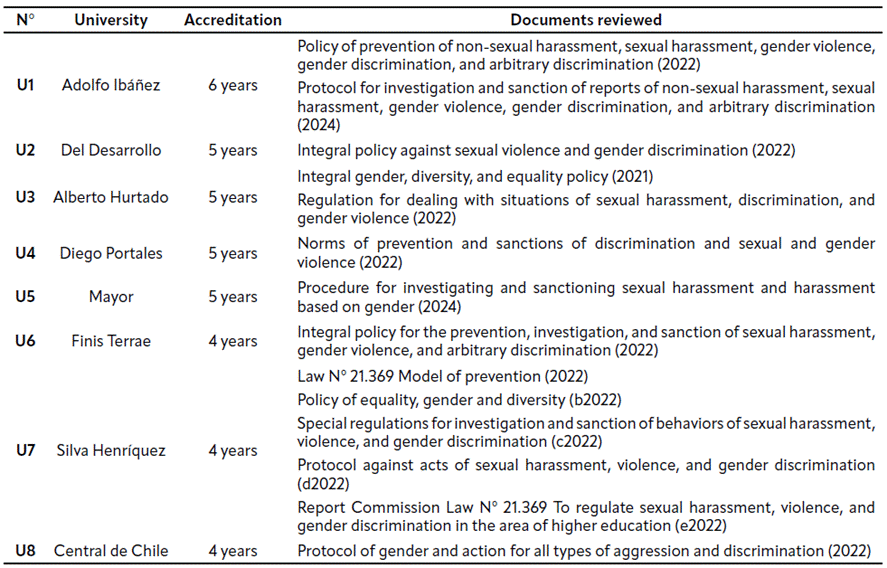
Given that the purpose of this work is to analyze institutional gender policies and norms associated with sexual harassment, violence, and gender discrimination, in the framework of the implementation of Law 21.369, in the context of private universities in Chile, a qualitative documentary research focus has been chosen, through which 14 public open-access documents associated with the aforementioned norm are reviewed. These documents come from 8 higher education institutions, whose inclusion criteria were; a) private universities from the Metropolitan Region; b) ease and open access to information of gender regulatory and policy documents on their institutional webpages; and c) 4 to 7 years of accreditation, which implies autonomy and guarantees of policies of quality (Comisión Nacional de Acreditación, 2023).
3.1.Categories and process of analysis
The categories of analysis for the revision of the documents were; (1) Institutional policy framework in matters of gender; (2) Models of prevention of harassment, violence, and gender discrimination; and (3) Models of investigation and sanction with the purpose of analyzing convergences and divergences of the different universities selected. The process of documentary analysis incorporated a series of stages associated with inventory of the documents available with open access to review their content in depth and extract elements for analysis in accordance with the categories of analysis, oriented to identifying trends, convergences, or contradictions that permit a comprehensive synthesis (Quintana & Montgomery, 2006).
4.Results and discussion
As indicated, the results center on, initially, dealing with the institutional policy framework for the models of prevention of harassment, violence, and gender discrimination, considering investigation and sanction processes, in the framework of a descriptive analysis of the regulatory and policy context of the different universities.
4.1.Institutional policy framework
The gender policies implemented in the selected universities have been mainly made to fit the indications made in Law N° 21.369, generating development and implementation that we observe as heterogenous. This is unlike those institutions that make up the Consortium of State-Owned Universities of Chile (CUECH), whose joint work has permitted an articulated implementation of languages, strategies, and models that allow for a substantial development in the issue, identifying those areas that need strengthening.
In a first approximation, it is possible to identify that all of the institutions meet the regulatory guidelines, associated with exhibiting an integral policy against sexual harassment, violence, and gender discrimination. This is composed of two instruments, the first of which is a model of prevention and second a model of sanction, although it is possible to find distinctions that point to the dispersion and heterogeneity of that panorama. This policy is consistent with promoting an education free from violence from factors associated with gender, that includes a preventative dimension and another reactive, or punitive, one. In the same vein, it is observed that all the universities under study have, within their gender policies, global principles that are aligned with that indicated in the Law, such as equality, gender equity, dignity, human rights, respect, safety, due process, diligence, and speed, even while some, to a lesser extent, incorporate specific elements that orient specific approaches to deal with the issue, such as intersectionality (U3, U5, U8), interculturality (U8) and a feminist approach (U8).
However, only two university refer directly, within their principles, to the educational process. Specifically, about non-sexist education, it is indicated that:
It permits the creation of spaces in which diverse roles socio-culturally attributed to men, women, and non-binary persons do not have a place and where the diversity of sexual orientations and gender identities is respected and valued. This implies the eradication of all formative acts or practices that reproduce discrimination, stereotypes, and gender biases (U3, 2021, p. 16).
This differs from that indicated about education from an approach associated with management:
So that actions for the prevention of non-sexual harassment, sexual harassment, gender violence and arbitrary discrimination are successful, it is necessary to incorporate education and reeducation activities in these matters that are to be found in permanent evolution (U1, 2022, p. 3).
In terms of the conceptualizations identified, the universities highlight the significance of key words consistent with what is proposed by the law, such as those mentioned in the previous paragraphs. In addition, albeit in a minority, some documents expressly mention sexual and generic diversity (U3, U4, U8), masculinities (U3), and intersectionality (U5, U8), and two institutions incorporate a Manual of non-sexist language (U3) while one incorporates a glossary about discrimination and violence (U8). With respect to the principles proposed in the contents, there are basic terms imposed by the law, and these are reflected in the related documents from all the universities, although there are specific mentions that indicate not only the semantic diversity, but also suggest diverse conceptualizations and interpretations, and even diverse approaches.
It is necessary to pay attention to this given that inclusion, from the perspective of gender, driven forward by social and academic movements, that impact the regulatory guidelines, begins to generate tension in institutional dynamics. This, in turn, generates tension with traditional models of formation and university culture, altering formal and informal institutional structures that have to be articulated with new principles and values contributed by the viewpoint of gender and manifest broader formative, cultural, and social requirements.
From an institutional point of view, the panorama is more diverse, in terms of their organization and branch, and inasmuch as there are varied instances and / or units involved in the issue, as can be appreciated in the following table:

As can be seen, all the units, which present diverse nominations, are committed to the implementation and follow up of the Integral Policy of Gender driven by the law, and depend mainly on Rectory (U1, U3, U6, U7), followed by General Secretary (U2, U4) and Academic Vice-Rectory (U5, U8). Only two of these units, among the declared purposes, make mention of areas that go beyond the law, specifically U4, that aspires to mainstream the perspective of gender, and U8 that aims to generate knowledge in the topic.
From these findings, it is necessary to point out that the issues dealt with in the global norms, as is the case in Law 21.369, clearly show an advance. However, the formative potential of these institutions should go through a cultural transformation that effectively implements, from these different dimensions, the purposes of a non-sexist education.
4.2.Models of prevention of harassment, violence, and gender discrimination
All of the universities include processes of diagnosis, information, diffusion, and awareness, as indicated by the law. However, there are distinctions that it is necessary to present:

Specifically, U4 dedicates a separate paragraph in its protocol to actions that promote gender equality and prevention of sanctioned behaviors, such as orientation and preparation of those who occupy positions of management and support in the Office of Curricular and Teaching Development in the incorporation of contents about gender and non-sexist education. On the other hand, U7 declares, as guidelines in their Policy of Gender Equality and Diversity (2022), specific dimensions such as equality in the representation and participation of women in the different decision making units, in positions of leadership and management, and in the insertion and promotion of the research trajectory of women, contributing to overcoming gender disparity and inequality in the world of science and technology, and contributing to communication with a gender focus, this avoiding sexist language. In the same vein, the guidelines are linked to is Integral System of Quality Assurance, indicating it as a central axis for monitoring actions, evaluation, and analysis that makes the mainstreaming of the gender approach fostered by the policy noticeable.
4.3.Investigation and sanction models for sexual harassment, violence, and gender discrimination
The universities have designed and implemented policies in line with the legal mandates, which are mainly reflected in the concepts they embrace to delineate their actions, the sanctions they have defined, and the internal and external supports they offer to those who have lived through harassment, violence, or gender discrimination. The following table lets us show these elements:

In general, the most utilized terms allude to harassment, violence, and gender discrimination, but it is interesting to distinguish the particularities, such as in U1, which is the only university to expressly mention cancelling, declaring that it “does not constitute a desirable mechanism for the solution of this type of conflict in the university community” (2024, p. 3)
On the other hand, U3 indicates in its regulations (2022) two terms that are not used in other institutions, the first referring to “environmental sexual harassment” which presents itself “when the person who exercises the sexual harassment creates intimidating, hostile, or humiliating academic or work surroundings for the affected person”. This has an individual component, as opposed to the second term used, that of “harassment by sexist environment” that has a collective character and is indicated as:
The creation of intimidating, hostile, or humiliating academic or work surroundings based on stereotypes of prejudices associated with sex, gender, or sexual orientation, when this is directed not towards one person in particular, but towards determined groups or categories of people in general. This is manifested in behaviors such as: homophobic comments or sexist insults, jokes, or gestures with unpleasant or offensive sexual content; sexual comments that can be annoying or rude; exhibition of material that is offensive for its sexist character, is sexually provocative or pornographic, among others (2022, p. 16).
For its part, U4 contributes, in its norms, the concept of sexual stalking, defined as:
The action, or set of actions, with sexual connotation directed towards a person without their consent and that attempt or have the effect of generating fear and insecurity. It implies behaviors such as following, observing, or watching a person, appearing at their place of residence, work, or study, calling by telephone, sending messages, recordings, photos, videos or objects of sexual connotation, without the consent of the person who receives them (2022, p. 3).
On the other hand, the indication offered by the same university with respect to the consumption of substances seems interesting. It indicates:
The consumption of alcohol and/or drugs could reduce or even eliminate the possibility of consent. Considering this, the fact of being under the influence of alcohol or drugs does exempt a person who commits behaviors of sexual violence, not does it make it possible to presume acceptance of the behavior from the person affected by it (2022, p. 3).
This is also indicated in U5, that refers to consent in art. 5°, indicating that:
The consent to participate in a behavior of a sexual nature or connotation can be given through words or actions that unequivocally show willingness to participate. Silence or lack of resistance does not imply consent. A person cannot give their consent if he or she does not have the ability to take or understand a decision due to a handicap or the consumption of alcohol or drugs. A person who is asleep or unconscious cannot give their consent. The consumption of alcohol or drugs does not justify or excuse behavior of sexual harassment or gender-based harassment (2024).
It is also noteworthy what U4 indicates with respect to romantic relationships, which it deals with in chapter XII, art. 75 and that indicates:
Romantic relationships between individuals of different hierarchies who are overage (boss-worker, teacher-student, tutor-student, etc.) and who form part of the University do not constitute in and of themselves prohibited behaviors and will not be sanctioned in this norm. However, consensual relationships between people of different hierarchy or sector must be reported to the corresponding authority (Vice-rector, Dean, School Director, or other) in order to avoid possible conflicts of interest (2022, p. 19).
This paragraph becomes important to the extent that it generates dilemmas in terms of privacy vs the potential for future conflicts. Another concept of interest is a contribution from U8 that includes the notion of “reprisals” as a sanctionable action and that is described as a form of revenge or threat towards the accuser on initiating the process of investigation (2022, p. 11).
In terms of sanctions, there is generally concordance, except U5, that includes for students:
The realization of non-renumerated activities in favor of the community or in benefit of people in vulnerable situations through organizations of recognized prestige. The time assigned to these activities will be determined in the resolution of this disciplinary measure (2024, Article 12).
This indication from the perspective of restorative justice can open an interesting debate, but it is not free from tensions. Additionally, from U8, some of the proposed sanctions could be complex in terms of their follow-up and proportionality, especially those referring to course or section relocation or the prohibition of contact during one semester.
In relation to the support mechanisms identified, the majority of the institutions mainly manage psychological, social, and, to a lesser extent, medical support to those who are going through violence, abuse, or discrimination. Additionally, U1 incorporates the figure of the Ombuds, and U4 the Ombudsperson, both focused on having people that make it possible to facilitate and monitor processes of situations coming from abuse or discrimination. However, on reviewing their purposes and roles, substantial differences are found. In the case of U4 there is incorporated into the norm (Title XI Of the Ombudsperson - Art. 73 and 74), a reference to this role, which is conceived as a professional person with a perspective of gender and human rights, who will act independently. Their main purposes are to review and analyze investigation and sanction procedures, interview people who have intervened in the procedures in order to evaluate their development and identify problems that recur during the development of the processes, indicating errors/failings, as well as pointing out established good practices and suggesting proposals.
In this sense, it differs from the figure included in U1. This Ombuds has as its mission to guide towards providing a welcoming space to face situations contained in the norm, in which orientation and information are offered, along with collaborative mechanisms for conflict solution, like mediation. The Ombuds is the one “who will determine which cases, considering their gravity, circumstances, or possible effects on the community, will not be susceptible to be put to mediation and must be channeled through a police report” (2024, Art. 24).
On the other hand, the reference to the incorporation of alternative or collaborative resolution of conflict is made by U4, revealing that those who apply this methodology are experienced professionals, distinct to the Ombudsperson, and this instance is conceived as possible in those cases of discrimination, sexual and/or gender violence when participation is consented by both parties and cannot be applied in cases when the accused person has previously been sanctioned or if one of the actions reported is indicative of a crime. (2022, Title VI Alternative resolution of conflicts, art. 33, 34, and 35). U8 also incorporates mediation as a collaborative mechanism of conflict resolution, indicated in its regulations as a reparative measure implemented through the Judicial Clinic of the institution and offered to the reporting party prior to the beginning of the investigative process (2022, article 16).
Independently of the way in which it is implemented, collaborative or alternative resolution of conflicts in cases of violence, harassment, or discrimination has been widely debated, as it supposes a balance in powers between those who participate, which in these cases, even with consent, can still be criticized. On the other hand, U7 offers spiritual support.
5.Final considerations
As has been pointed out, in recent years the Chilean higher education system has advanced towards different policies to diminish gender gaps and inequalities. These policies grew from the signing into law of Law N° 21.369, with a view to institutionalizing gender policies. As one study indicates, this law has been preceded by different social movements that were expressed in universities, but, in turn, represent a complex challenge when it comes to their implementation (Ramírez, 2023). On the other hand, while it is true that the law is considered as a turning point, it is also true that it creates tension in the institutional structure and in teaching, opening debates about university autonomy or academic freedom (Alvarado Urízar et al., 2022b, p. 237).
For this reason, there are certain suspicions in relation to whether the incorporation of gender policies, including those that the law obligatorily includes, can be done from an administrative point of view, one that does not necessarily aim at questioning the patriarchal and androcentric structure of knowledge and universities. The risk, in this case, would be “that those initiatives entail and unfurl when they administer, decree, sanction, and turn gender into ‘administrative business’ or that, without a critical and feminist organizational reflection, they just ‘put it to work’ (Mandiola et al., 2022, p. 92), which could imply a cosmetic incorporation of the changes.
At the same time, studies of the perception of Law 21.369 and university gender policies, carried out among male academics indicate the existence of a positive valuing of the law as an expression and recognition of feminist demands, even when there is a certain distrust of its effects, inasmuch as a lack of commitment is observed from the institutions themselves and their managerial positions (López Dietz, 2024). In parallel, it would seem that the concentration on sexual harassment and gender discrimination leaves out other issues that are relevant for moving forward with policies that would allow us to reach true gender equality.
It is worth noting that the Higher Education Superintendency recently published a document to update some elements of the law, arguing the need for the institutions to have a repository or unified document, disseminated through clear and expedited channels, insisting on the participation of the community through its distinct areas -academics, administrative staff, and students- with a criterion of gender parity or, in specific cases, an adequate representation, that must include non-binary people. It also asserts that these policies should be validated by the community.
In terms of the units in charge of this, it indicates that the personnel must be trained in human rights and gender, and that there must exist bodies to implement these policies and plans, while others are dedicated to investigation and sanction. In the same vein, it aims towards the principle of independence, dedicated to “guaranteeing that the responsible institutional bodies must have the functions of investigation and sanction” (Superintendencia de Educación Superior, 2023, p. 5).
In the framework of the universities studied, it is possible to indicate that those institutions have advanced by including models of prevention, accompaniment, investigation, and sanction to meet the obligations stated in the law. This constitutes an improvement in relation to the situation of years before, when the claims of harassment or violence were made invisible. Even with these advances, it is observed that there is a diversity of ways in which the norm is implemented, with different professional teams, whose composition varies in number.
With respect to prevention models, all the universities take into consideration processes of diagnosis, information, diffusion, and sensitization, access to which is open. It is possible to observe nuances in aesthetics and form, although the universities do not explicitly explain evaluation and/or systematization instruments that would allow us to evaluate their response, efficacy, and/or impact.
On the other hand, the concepts associated with sexual harassment, gender violence, and discrimination are similar, although some universities specify violence in virtual spaces and harassment generated in sexist environments, as well as particular phenomena such as cancelling, abusive sexual harassment, sexual stalking, sexual aggression, and non-consensual sexual exposure.
In terms of sanction, they incorporate verbal and written warnings, suspension, and expulsion for students, while for academics and administrative staff, warnings, fines, and contract termination are applied. In relation to support, the universities offer psychological, legal, and social assistance and, to a lesser extent, medical support, accompaniment in reporting to police, and derivation to external networks.
Within this diversity, specific supports are highlighted such as emergency conflict resolution mechanisms, the figure of the Ombuds/Ombudsperson, and, in one case, spiritual support, all of which are linked to the institutional seals on one hand, and to the resources arranging those service implies on the other.
In global terms, the universities studied have implemented actions and strategies imposed by the law, which have meant an advance with respect to the visibility and treatment of gender violence, fulfilling what the law establishes. However, there are many aspects not yet dealt with, such as curricular incorporation and changes in the sexist culture that exists in universities, the recognition of the contribution of feminist epistemologies, among others, that are fundamental if we aspire to generate a more sustainable change.
Declaraciones
Author contributions Ana López Dietz: Conceptualization - Formal analysis - Writing of original draft - Research - Methodology - Redaction, revision and editing. Ana María Galdames: Conceptualization - Formal analysis - Writing of original draft - Research - Methodology - Redaction, revision and editing. Alejandra Álvarez-Sagredo: Data recovery.
Conflicts of interest The authors declare no conflicts of interest in relation to the elaboration or publication of this article.
Referencias
- Alcázar, J. (2021). Feminismos y performance en América Latina. El tendedero y Un violador en tu camino. Cuadernos del CILHA, 22(2), 322-353. https://doi.org/10.48162/rev.34.031.
- Alvarado Urízar, A., Rivera Müller, F., y Suazo Guacte, F. (2022). Educación no sexista en los protocolos de género en las universidades chilenas: Evaluación diagnóstica y perspectiva crítica. Revista de Pedagogía Universitaria y Didáctica del Derecho, 9(2), 291-322. https://doi.org/10.5354/0719-5885.2022.68257.
- Alvarado Urízar, A., Rivera Müller, F., y Suazo Guacte, F. (b2022). Protocolos de género y Ley 21.369: “Hacia una “educación feminista” en las universidades chilenas. Revista de ciencias sociales, (80), 183-251. https://dx.doi.org/10.22370/rcs.2022.80.3341.
- Angulo, C. (2023). Aportes de la Ley 21.369 de 2021 a la regulación del acoso sexual en Educación Superior. UCMaule, (65), 9-25. https://doi.org/10.29035/ucmaule.65.9.
- Bayard, V.; Plante, E.; Cohn, E.; Moorhead, C.; Ward, S.; Walsh, W. (2005). Revisiting unwanted sexual experiences on Campus. A 12-Year Follow-up. Violence against women, 11, 426-446. https://doi.org/10.1177/10778012042743.
- Bonder, G. (Comp.). (2022). La institucionalización del enfoque de igualdad de género en Universidades de América Latina. UNESCO, FLACSO.
- Buquet, A.; Cooper, J.; Mingo, A. y Moreno H. (2013). Intrusas en la universidad. México: UNAM, PIEG, ISSUE.
- CEDAW. (1992, 29 de enero).Recomendación General N 19: La violencia contra la mujer.
- Comisión Económica para América Latina y el Caribe, CEPAL. (2016). El acoso y hostigamiento sexual en el ámbito laboral y educativo: violencia contra las mujeres invisibilizada. Notas para la Igualdad. Observatorio de Igualdad de Género de América Latina y el Caribe, N° 21.
- Comisión de Igualdad de Género del CRUCH. (2022). Lineamientos para establecer una política de igualdad de género en las universidades del Consejo de Rectoras y Rectores (CRUCH).
- Comisión Nacional de Acreditación. (2023). Criterios y estándares de calidad para la acreditación institucional y de programas. CRUCH.
- Consorcio de Universidades del Estado de Chile. (2022). Tendencias de brechas en las 18 universidades del CUECH. https://genero.uestatales.cl/reel/tendencias-de-brechas-en-las-18-universidades-del-cuech/
- Crocco-Valdivia, A., & Galaz-Valderrama, C. (2023). Mujeres en la academia: Exploración de una organización generizada a partir de una revisión sistemática. Estudios pedagógicos, 49(2), 439-454. https://dx.doi.org/10.4067/S0718-07052023000200439.
- Daich, D. & Varela, C. (2020). Los feminismos en la encrucijada del punitivismo. Biblos.
- DeKeseredy, W. y Schwartz, M. (1998). Woman abuse on campus: Results from the Canadian National Survey. Thousand Oaks, CA: Sage.
- Fedina, L., Holmes, J. L., y Backes, B. L. (2018). Campus sexual assault: A systematic review of prevalence research from 2000 to 2015. Trauma Violence and Abuse, 19(1), 76-93. https://doi.org/10.1177/1524838016631129.
- Fernández Cruz, J. (2020). Los protocolos universitarios para la prevención y sanción de la violencia, acoso y discriminación entre estudiantes: una mirada criminológica y político-criminal. Revista de derecho (Valdivia), 33(2), 297-317. https://dx.doi.org/10.4067/S0718-09502020000200297.
- Flores-Bernal, R. (2019). Políticas de educación superior sobre acoso sexual en Chile. Educación y Educadores, 22(3), 343-358. https://doi.org/10.5294/edu.2019.22.3.1.
- Fuentes-Vásquez, Lya Yaneth. (2019). "Cuentos que no son cuentos": acoso sexual, violencia naturalizada en las aulas universitarias. Nómadas, (51), 135-153. https://doi.org/10.30578/nomadas.n51a8.
- Galdames Paredes, A. y López Dietz, A. (2024). Una mirada inicial a las políticas institucionales de género y educación no sexista: desafíos y reflexiones sobre las universidades privadas en Chile. En: López Dietz, A. y Galdames A. Educación No sexista: debates, desafíos y proyecciones en la Educación Superior (pp. 21-38). Editorial Tirant lo Blanch, Universidad Central de Chile.
- Galdames,A. y Venegas, A. (2022). Violencia de pareja en estudiantes universitarios. En Pensamiento Jurídico Central (Vol. 4, pp. 436-365). Editorial Tirant Lo Blanch.
- García Prince, E. (2008). Políticas de igualdad, equidad y gender mainstreaming ¿De qué estamos hablando? Marco conceptual. Programa de Naciones Unidas para el Desarrollo.
- Harris, J. C., Cobain, K. P., y Karunaratne, N. (2019). Reimagining the study of campus sexual assault. In Perna L. (Ed.), Higher education: Handbook of theory and research, (pp. 1-47). Springer. https://doi.org/10.1007/978-3030-11743-6_12-1.
- Hiner,H. y López Dietz,A.(2021).¡Nunca más solas! Acoso sexual, tsunami feminista, y nuevas coaliciones dentro y fuera de las universidades chilenas. Polis, 20(59), 122-146. http://dx.doi.org/10.32735/s0718-6568/2021-n59-1590.
- Klein,L. B.,Brewer,N. Q.,Mennicke,A.,Christenson,C.,Baldwin-White,A.,Cloy,C., yWood,L.(2020).Centering minoritized students in campus interpersonal violence research.Journal of Family Violence,36(7),911-921.https://doi.org/10.1007/s10896-020-00223-8.
- Ley 21.369. (2021). Regula el acoso sexual, la violencia y la discriminación de género.https://www.bcn.cl/leychile/navegar?idNorma=1165023.
- López Dietz,A.(2024).Percepciones sobre la Ley 21.369 sobre acoso sexual en universidades chilenas.Justicia,29(46),https://doi.org/10.17081/just.29.46.7797.
- Mandiola,M.;Ríos N. yEridani,A.(2022). El género administrado: lecturas feministas y críticas a la reorganización de la academia y las universidades en Chile. En:VVAA.Mucho género que cortar: estudios para contribuir al debate sobre género y diversidad sexual en Chile. (pp. 73-102). Santiago: Programa de Investigación de Género y Diversidad Sexual GEDIS, Universidad Alberto Hurtado.
- Ordorika, I. (2015). Equidad de género en la educación superior. Revista de la Educación Superior, 44(174), 7-17. https://doi.org/10.1016/j.resu.2015.06.001.
- Quintana, A. & Montgomery, W. (2006). Psicología: Tópicos de actualidad. UNMSM.
- Ramírez, L. (2023). Movimientos sociales y cambios normativos en la educación superior. El caso de la Ley N 21369. En: Labraña, J. et al. Redefiniendo la educación superior chilena: cambio organizacional y nuevas formas de gobernanza. (pp. 119-136). Santiago: Ediciones Universidad Diego Portales.
- Rico, N. (1996). Violencia de género: un problema de derechos humanos. Santiago: CEPAL.
- Scott, Joan (2002). El género: una categoría útil para el análisis. Revista Del Centro De Investigaciones Históricas, 14, 9-45. https://revistas.upr.edu/index.php/opcit/article/view/16994.
- Superintendencia de Educación Superior. (2023). Oficio circular N 001.https://www.sesuperior.cl/wp-content/uploads/2024/03/OF_CIRC_001-ley-21369.pdf.
- Universidad Adolfo Ibañez. (2022). Política de prevención de acoso no sexual, acoso sexual, violencia de género, discriminación de género y discriminación arbitraria. https://uai.cdn7pm.net/documentos/politicade-prevencion-de-acoso-no-sexual-acoso-sexual-violencia-de-genero-discriminacion-de-genero-ydiscriminacion-arbitararia.pdf.
- Universidad Adolfo Ibañez. (2024). Protocolo de investigación y sanción frente a denuncias de acoso no sexual, acoso sexual, violencia de género, discriminación de género y discriminación arbitraria. https://uai.cdn7pm.net/documentos/protocolo-investigacion-y-sancion-denuncias-acoso-violencia-y-discriminacion.pdf.
- Universidad Alberto Hurtado. (2021). Política Integral de género, diversidad y equidad. https://uahurtado.cl/wpcontent/uploads/2023/07/Modelos-de-prevencion-y-de-investigacion-y-sancion-ante-el-acoso-sexualviolencia-y-discriminacion-de-genero.pdf.
- Universidad Alberto Hurtado. (2022). Reglamento de abordaje ante situaciones de acoso sexual, discriminación y violencia degénero. https://uahurtado.cl/wp-content/uploads/2023/07/Reglamento-de-abordaje-antesituaciones-de-acoso-discriminacion-y-violencia-de-genero.pdf.
- Universidad Central de Chile. (2022). Protocolo de género y actuación ante todo tipo de agresión y discriminación. https://www.ucentral.cl/gyd/docs/protocolo_genero_ucentral.pdf.
- Universidad del Desarrollo. (2022). Política integral contra el acoso sexual violencia y discriminación de género. https://www.udd.cl/dircom/web/Politica-Integral-Acoso-Sexual-Violencia-y-Discriminacion-de-Genero.pdf.
- Universidad Diego Portales. (2022). Normativa de Prevención y sanciones de Discriminación, Violencia sexual y de género. https://genero.udp.cl/wp/wp-content/uploads/2022/06/RESOLUCION-RECTORIA-No-03-APRUEBAMODIF.-NORMATIVA-DE-VIOLENCIA-2022-1.pdf.
- Universidad Finis Terrae. (2022). Política integral de prevención, investigación y sanción del acoso sexual, violencia de género y discriminación arbitraria. https://finis.cl/descargables/politica-integral-contra-el-acoso-sexualviolencia-y-discriminacion-uft.pdf.
- Universidad Mayor. (2024). Procedimiento para investigar y sancionar el acoso sexual y el acoso basado en género. https://www.umayor.cl/transparenciaumayor/descargas/PROCEDIMIENTO_PARA_INVESTIGAR_Y_SANCIONAR_EL_ASVDG.pdf.
- Universidad Católica Silva Henríquez. (2022). Ley Nª 21.369 Modelo de prevención. https://www.ucsh.cl/assets/uploads/2022/10/modelo_de_prevencion.pdf.
- Universidad Católica Silva Henríquez. (b2022). Política de Igualdad, género y diversidad. https://www.ucsh.cl/assets/uploads/2022/10/politica_de_igualdad_de_genero_y_diversidad.pdf.
- Universidad Católica Silva Henríquez. (c2022) Reglamento especial de investigación y sanción frente a conductas de acoso sexual, violencia y discriminación de género. https://www.ucsh.cl/assets/uploads/2022/10/reglamento_especial_de_investigacion_y_sancion_frente_a_conductas_de_acoso_sexual_violencia_y_discriminacion_de_genero.pdf.
- Universidad Católica Silva Henríquez. (d2022). Protocolo contra actos de acoso sexual, violencia y discriminación de género. https://www.ucsh.cl/assets/uploads/2022/10/protocolo_contra_actos_de_acoso_sexual_violencia_y_ discriminacion_de_genero.pdf.
- Universidad Católica Silva Henríquez. (e2022). Informe Comisión Ley N° 21.369 Para regular el acoso sexual, la violencia y la discriminación de género en el ámbito de la educación superior. https://www.ucsh.cl/assets/uploads/2022/10/informe_comision_ley21369.pdf.
- Valls Carol, R. (2008). Informe 2: Trabajo de campo cuantitativo. ¿Violencia de género en las universidades? Realidades, formas y superación. En: Violencia de Género en las Universidades Españolas. Guía de prevención y atención. (pp. 1-16). Madrid: Instituto de la Mujer. Ministerio de Igualdad.
- Voth Schrag, R. J. (2017). Campus based sexual assault and dating violence: A review of study contexts and participants. Affilia: Feminist Inquiry in Social Work, 32(1), 67-80. https://doi.org/10.1177/0886109916644644.
- Zerán, F. (editora). (2019). Mayo feminista. La rebelión contra el patriarcado. Santiago de Chile: LOM.
Notes
- Ethical implications There are no ethical implications to declare in the elaboration or publication of this article.