ABSTRACT
Writing is an epistemological tool of knowledge that enables the communication of knowledge. Its exercise is an individual, cognitive and cultural act that enables discursive interaction and the manifestation of a community identity. The situation of its teaching and, with it, learning in higher education seems to be strained by an idea that repeats itself in a continuous evolution: students do not enter university with solid knowledge of written production; they do not know how to write. However, from critical voices comes the real questioning of this premise and, specifically, how true this prejudiced deficit is. The present study aims to propose a model of academic writing, based on a social, cognitive, metalinguistic, coevaluative construct with emphasis on feedback. In order to arrive at this representation of the writing task, some of the main production models that have marked the history of writing are reviewed. Likewise, we reflect on what space this academic literacy has in tertiary education.
KEYWORDS: Didactics; writing; higher education; learning process
RESUMEN
La escritura constituye una herramienta epistemológica de saberes que posibilita la comunicación de conocimientos. Su ejercicio es un acto individual, cognitivo y cultural que faculta la interacción discursiva y la manifestación de una identidad comunitaria. La situación por la que atraviesa su enseñanza y, con ello, el aprendizaje en educación superior pareciera estar tensionada por una idea que se repite en un continuo devenir: los estudiantes no ingresan a la universidad con sólidos conocimientos en materia de producción escrita; no saben escribir. Sin embargo, desde las voces críticas nace el real cuestionamiento de esta premisa y, en concreto, qué tan cierto es este prejuicioso déficit. El presente estudio tiene por objetivo proponer un modelo de escritura académica, sobre la base de un constructo social, cognitivo, metalingüístico, coevaluativo y con énfasis en la retroalimentación. Para llegar a esta representación de la tarea de escribir, se revisan algunos de los principales modelos de producción que han marcado la historia de la escritura. Asimismo, se reflexiona sobre qué espacio tiene esta literacidad académica en la educación terciaria.
PALABRAS CLAVE: Didáctica; escritura; enseñanza superior; proceso de aprendizaje
1. Introduction
Academic writing, in the university setting, represents an essential communication skill both for its epistemic potential, as it is one of the main tools in the construction and communication of knowledge (Adler-Kassner & Wardle, 2015; Bazerman et al., 2016; Camps & Castelló, 2013; Cerda, 2022; Miras & Solé, 2007; Serrano, 2014), and for its role in students cognitive and metacognitive learning processes (Cassany, 1988; Grupo Didactext, 2015). This enabling and functional view of the art of writing makes literacy practices a challenge, a complex network from which one never stops learning (Bazerman, 2017) and one of the determining factors in students' access to and retention of learning in their first year of professional training (Ezcurra, 2011).
University degrees are characterized by their own culture, which involves writing practices that address genres of greater rhetorical complexity and do not always coincide with the knowledge acquired by students in their school education and, in some cases, are completely different from what they learned in school (Bazerman, 2017). "The university is described by students as 'a new world, where they face challenges related to demands, reading requirements, and the ability to write analytically'" (Ávila et al., 2021). However, despite multiple studies describing this practice as a transversal skill (Ávila et al., 2013; Cáceres & Villamil, 2013; Carlino, 2004; Eiras et al., 2018), its relevance is not usually explicitly addressed in the university curriculum (Navarro et al., 2020).
According to Ávila et al. (2021), testimonies from university students show that teachers in various academic areas do not guide the writing process for the assignments they request, as there is a belief that students already know the genre required, perpetuating the idea of writing as a generic activity. Likewise, many teachers believe that providing guidelines to guide the writing and evaluation process is detrimental, and as for feedback, it is scarce and tends to focus on the unsuccessful aspects of the assigned task. Furthermore, various studies show a lack of clear instructions in writing tasks (Ávila et al., 2021; Carroll, 2003; Lea & Street, 1998).
2. Background
There is a widespread belief that students who successfully navigate the selection processes required for admission to higher education have the necessary knowledge to successfully perform various writing tasks specific to their undergraduate degree program. However, this expectation contrasts with the reality of students in their first year of university education, who experience difficulties that often generate a perception of "deficit," that is, the belief that new university students have insufficient training, which contributes to a lack of skills and/or knowledge that professors consider basic. This idea is common in expanding university systems and is validated by the growing diversity of the student body (O'Shea et al., 2016; Smit, 2012).
The deficit or normative assessment paradigms (Lillis, 2017) in academic writing, as noted by Ávila et al. (2019), ignore "the complex transitions of these writers in their academic journey. Nor do they highlight their actual practices, their knowledge, the difficulties they experience, and the multiple learning opportunities, topics of interest, and vernacular literacy practices..." (p.12). Thus, it is erroneous to expect that the transfer and application of prior writing knowledge will occur without mediation, as this implies ignoring the complexity of a non-generic skill (Wardle, 2013) and the distinguishing characteristics of different academic genres.
In this context, it is necessary to recover one of the basic precepts in the construction of meaningful learning, proposed by Ausubel (1989): the need to establish a relationship between new knowledge and the learner's existing cognitive structure in a non-arbitrary and substantial way. This interrelationship should be included as a basic pedagogical practice in university classrooms, that is, it should appeal to the recovery of students' previous experiences and learning in the area of writing (even those carried out in informal contexts) and use them to construct (and not just acquire) knowledge of academic genres. In other words, the teaching of writing should not overlook so-called vernacular writing, that is, those literacy practices that "correspond precisely to the realm of personal experiences, understood as forms of social participation that promote (or not) integration into a disciplinary culture." (Ávila, 2019, p. 7). These represent valuable anchors in the construction of new knowledge.
The vernacular practices of university students are diverse. In this regard, their active role in social networks, where reading and writing are frequently practiced, stands out, as do fictional creations that reaffirm the identity of writers (Ávila et al., 2020; Ávila et al., 2021). Likewise, it is possible to affirm that there is a correlation between writing and reading for non-academic purposes and the application of effective strategies for learning at university (Ávila et al., 2019).
2.1 Towards effective support in the construction of learning around academic writing
Various studies offer methodological insights for the effective construction of the learning required for successful writing practices. These guidelines arise from research into undergraduate students' perceptions of writing (Elliot et al., 2018; Eodice et al., 2019; Nallaya, 2018; Naroa & Álvarez, 2019; Navarro et al., 2020), as it is understood that students' experiences allow for a greater understanding of the processes, social practices, methodologies, and strategies that enable written development.
The idea of an agent or promoter of literacy is conceptualized in the term sponsors, which can be defined as "any agent, local or distant, concrete or abstract, who enables, supports, teaches, and models, as well as recruits, regulates, suppresses, or retains literacy" (Brandt, 2004, p. 19). However, this concept overlooks the leading role of the student. This is why in the teaching-learning process of writing, as in reading-literacy education and other literate practices, the presence of a mediator is required, that is, someone who accompanies the construction of new knowledge through writing (Serrano, 2014). This is even more so when considering that writing acquires significant value for students when it is practiced in interaction with others: teachers, writing tutors, students, or members of the community (Eodice et al., 2019).
As in other literacy practices, mediators emerge as important figures in the development of students as writers. These can be family members, friends, peers, and subject assistants (Alder, 2016), with the subject teacher as the main promoter (Ávila et al., 2019). Furthermore, it is the students who later assume the role of literacy promoters in their communities (Trigos-Carrillo, 2020).
3. Writing models: some theoretical insights
Writing, as a process of communication, is present in all dimensions of human development. Its existence is visible in its individual and cognitive component (mediated by literacy) and as a social and collective process (linked to the historical development of activities carried out in society). It is constructed from a variety of levels, which is why it has been the subject of study in relation to teaching and learning processes (Ávila & Calle-Arango, 2022). Thus, a representational model of writing processes promotes understanding of the writing system and its individual, cognitive, social, and collective dimensions.
In light of the above, a model is a theoretical construct that aims to represent the essence and work of certain dominant structures. Likewise, through a specific approach, it brings together criteria and supports the textual actions that are generated in the discipline. This differs from theory, since the latter explains a phenomenon (textual production), while the model is a metaphor that explains and shapes the theory. With this, the theoretical turns to the dynamic and the model to the static (Álvarez & Ramírez, 2006).
Finally, it should be noted that writing models are based on learning theories, whether behavioral, constructivist, cognitive, social, or pragmatic.
3.1 Classic models: linear and stage-based
Classic writing models are working frameworks characterized by a flat, unidirectional approach to code treatment. They embody the product-process opposition, favoring a clear, rigid orientation. In this regard, the writer’s agency is focused primarily on issues of form rather than content and/or discursive purpose. Models such as linear and stage models are recognized.
Regarding the first model, Parodi (2003) argues that it is linear in nature with a preference for the written product, that is, it values writing as a result and not as a process, while leaving out the metacognitive phases. In practical terms, this classic representation favors the codifying elements of the text's surface (spelling), as well as the centrality of grammatical aspects, over the writing process.
As for the second model, Rohman (1965), in the 1960s, proposed a new way of approaching text writing, through three stages: pre-writing, writing, and rewriting. Cassany (2008) points out that this author is one of the first to take an interest in studying production skills as a complex process. He also states that Rohman (1965) is particularly interested in the first stage of the process, given that the person must actively think about the topic, explore different ideas, and look for an image or model as a reference. Thus, it is thought that "the type of discovery (or way of thinking) in pre-writing determines the success of written communication" (Cassany, 2008, p. 121).
However, both models are questioned. On the one hand, the linear model is countered by its attachment to the formal constructs of language (grammaticalist approach) and, with that, the imminent displacement of content. On the other hand, the stage model is questioned because it is unidirectional and assumes that the writer develops the writing process in a hierarchical and structured way (Parodi, 2003). Nevertheless, the latter is a timid attempt to schematize written composition, which will later be reformulated by cognitive approaches in terms of recursion and flexibility (Flower & Hayes, 1981).
3.2 Cognitive models
For Marincovich (2002), cognition-centered models are part of one of the most radical transformations in the field of text production. They emerged as a result of the rise of cognitive psychology in the 1960s and, on a functional level, are evident in the incorporation of the processual component at the moment of writing. This working mechanism suggests that different higher-order cognitive thinking skills are exercised in the composition of a text (Rodríguez, 2020), on the understanding that writing is a recursive process involving procedures such as planning, textualizing, and revising.
Cognitive activity has three starting points: (1) the possibilities of studying the mind; (2) higher-order skills composed of processes and subprocesses; and (3) the generation of hypotheses by learners when they are performing tasks that require linguistic skills (Marincovich, 2002). In this vein, we will refer to two works: the model by Flower & Hayes (1981) & the model by Scardamalia & Bereiter (1982, 1987).
3.2.1 Flower & Hayes' model (1981)
In the 1980s, Flower & Hayes (1981) proposed a prototypical construction that breaks with the linear and unidirectional approach to writing (Álvarez & Ramírez, 2006). It is considered one of the first models to explain what happens at the level of mental operations and is characterized by being a theory of processes that, in turn, distances itself from linear models. In the same vein, it uses a recursive (almost cyclical) sequence, where the producer stops at different moments of the model depending on the task (Benítez, 2005).
The model by Flower & Hayes (1981) vehemently rejects Rohman's (1965) stage model, given its rigid composition of writing. Parodi (2003) argues that the main criticism lies in the absence of a recursive process which, being so inflexible, nullifies the possibility of reviewing previous tasks and checking the planning. Consequently, writing cannot be fragmented.
According to Benítez (2005), the proposal is organized into three general components: "the context of the task, the processes of composition, and the writer's long-term memory" (pp. 57-58). The first is structured into two subcomponents: the rhetorical situation and the text produced up to a certain point. The second is divided into three stages: (1) planning; (2) textualization; and (3) revision. The last component (long-term memory) delves into the prior knowledge of text producers and the management of the audience to whom their writing is directed (Benítez, 2005).
3.2.2 Bereiter & Scardamalia model (1982, 1987)
In the words of Álvarez & Ramírez (2006), "Bereiter & Scardamalia (1982, 1987) propose a model in which, in general terms, they suggest cognitive and metacognitive processes linked to the processes of planning, textualization, revision, and editing" (p. 40). In their study of the cognitive processes of production, they proposed two models of writing that, in effect, allow novice writers to be differentiated from experts (Marincovich, 2002). The first of these is called "telling knowledge", and is associated with novice, immature writers or those with little experience in writing tasks. This model starts with a mental reconstruction of the topic (preliminary ideas) and then locates elements that recreate the topic and structure the genre. Based on this, if the information collected is relevant, it is translated into writing (Marincovich, 2002). The second model, "Transforming knowledge," conceives of the first as a subprocess and deploys more complex skills. In this case, we are dealing with a mature writer who solves the problem of composing a text based on the content problem space and the rhetorical problem space (Marincovich, 2002). In effect, this model involves a constant process of textual problematization.
3.3 Sociocultural-sociocognitive models
3.3.1 Didactext model
This model is based on Hayes' (1996) proposal, which views the writing process as a complex activity, since "cultural, social, emotional or affective, cognitive (visuomotor), discursive, semantic, pragmatic, and verbal factors intervene in an interrelated manner" (Didactext, 2003, p. 78).
The model focuses on cognitive components and their link to social and cultural factors. It aims to improve writing practices in academic contexts, with an emphasis on compulsory education (Álvarez & Ramírez, 2006). According to the representational construct, three dimensions interact: cultural sphere, contexts of production, and the individual. "Didactext rescues the condition of the subject as a producer of meaning and history and as a user of cultural memory who represents, negotiates, and constructs meanings in the elaboration of the text" (Álvarez & Ramírez, 2006, p. 52).
Regarding the components of the model, the initial proposal from 2003 contemplates four phases (access to knowledge, planning, textual production, and revision). However, the reformulation of the model, carried out in 2015, incorporates two new phases: editing and oral presentation (Didactext Group, 2015).
3.3.2 Corrigan & Slomp Model (2021)
This sociocognitive model has been in place since the digital age. It arose from a theoretical review of writing research over the last 50 years, based on an analysis of 109 publications. From these, it concludes the recurring presence of seven theoretical constructs, including: metacognition, critical discourse, discursive community, rhetorical purpose, genre, task process, and substantive knowledge, albeit in a fragmented manner. Corrigan & Slomp (2021) reaffirm the need for a holistic model that correctly integrates these domains. To this end, they specify the key components and move from a nomothetic model to an ideographic one. The network of content articulated in the model locates writing from three perspectives: (1) writing as a tool for problem solving, (2) writing and its cognitive and sociocultural orientation, and (3) writing in the discursive space of the 21st century.
4. Assessment of academic language
The assessment of writing should be understood as a necessary practice for verifying the achievement of learning associated with literacy. It requires the definition of criteria (Crespo, 1998; Sotomayor et al., 2015), as these constitute a benchmark for the evaluation of writing. This practice is based on the principles of assessment for learning, and it is essential to understand that the term draws on different theoretical currents and emphasizes different focuses.
To understand its presence in written production, it is essential to go back to what Yancey (1999) calls waves; according to the author, the assessment of writing can be organized into phases, which respond to a marked cultural construct. Likewise, they emerge from the historical understanding of the concepts of reliability and validity. A wave would have the characteristic of overlapping the previous one, without completely displacing what has been established.
These historical moments in the evaluation of writing are organized as follows:

Yancey's (1999) postulates coincide with those of Valenzuela (2022), in the Chilean context, who states that indirect assessment of writing could be seen in university entrance exams 1, when indicators of text production and writing plans were measured, conceiving writing as a mechanical and generic activity and nullifying the idea of complex and situated activity. It should be noted that in Chile, after eliminating these items from the tertiary education entrance exam, there is no assessment that measures this skill; the test focuses solely on reading comprehension.
However, considering the diversity of academic genres that serve as spaces for the coexistence of disciplinary languages at the university, teachers must develop valid, reliable, and objective tools. Similarly, they must develop evaluative literacy (Förster, 2017; Stiggins, 1991), understood as an understanding of the process in terms of its knowledge and execution (Popham, 2006; Stiggins, 1991). In this vein, for example, Sotomayor et al. (2015) argue that rubrics are an ideal tool for evaluating writing, as they provide descriptions of student performance based on criteria associated with a learning objective. The authors detail the steps for constructing rubrics that allow for the assessment of written production development; they state four general criteria that bring together the core of the textualization process, namely: (1) appropriateness to the communicative situation, (2) coherence, (3) cohesion, (4) structure. Following another example, Andueza (2019), in reference to tasks that assess Specific Writing Skills (SWS), also proposes criteria/indicators based on an analytical rubric: (1) thematic progression, (2) consistency of ideas, (3) information density, (4) academic stance, (5) understanding of the source text, (6) integration of ideas from the source text, (7) citation, (8) spelling and punctuation, and (9) adjustment to the discursive genre. Thus, it seems clear that a key element of the writing-teaching process is assessment, its tools, and, indeed, strategies such as feedback.
4.1 Are assessment and correction the same task?
Ribas (2011) places assessment in language and literature as a practice that shares foundations and notions with other curricular areas, although he recognizes its degree of specificity, given the object of study and the particular practices that are carried out in the teaching processes. In line with the above, he outlines three key elements in any assessment process: definition and observation of the subject; analysis based on criteria or model references; and decision-making and communication of information. It should be noted that in the field of text production, it is important to differentiate between correcting and assessing, as they are not identical practices.
On this point, Cassany (2009) establishes the difference between evaluating and correcting, arguing that these terms are very commonly confused. Evaluating consists of making a judgment about specific characteristics, all within a specific and defined context. From a curricular point of view, evaluation varies depending on the moment and agent (Förster, 2017) and as a pedagogical practice, when evaluating a text, for example, the respective analysis is carried out (identification of errors, consideration of correct questions, and assessment with a score). However:
In no case does assessment necessarily imply the revision of the text by the teacher or student, or the search for and annotation of the correct solutions. Assessment ends with the attainment of judgment or evaluation. What is done with the data provided by the assessment is another matter (Cassany, 2009, p. 26).
Correction, on the other hand, involves the use of this data to communicate with students so that they can analyze their errors and improve over time.
4.2 Corrective feedback in written production
Feedback in written production is part of current studies focused primarily on academic texts. In this regard, Tapia-Ladino et al. (2017) define Written Comments on Genre Adjustment (CEAG) as a system that guides the materialization of genre in the discursive goal. This process is dialogical, as a dynamic develops between teacher and student through this written feedback.
Studies on feedback specify its focus. Hattie & Timperley (2007) indicate that the relevance of this practice lies in the student analyzing the degree of difference between what they understood and what they needed to understand. They also distinguish four areas for feedback: (1) Task-based: focused on evaluating a task or product, with corrective intent. (2) Process-based: aimed at providing feedback on the task, considering the steps taken. (3) Self-regulation-based: linked to the student's monitoring of their own learning, and (4) Person-based: related to the student's attitudinal aspects.
Specifically, the task of correction provides useful guidance to the student, especially when the literature defines learning to write as a difficult task. However, the research concludes that much of the feedback focuses on elements of form. Regarding feedback,Cassany (2021) concludes that corrections are superficial and focus solely on aspects such as spelling and vocabulary. He also states that psycholinguistics has shown that the task of writing and learning to write are complex processes, in which students with ten years of schooling develop moderate competence.
According to specialists, writing a two-page essay (coherent, cohesive, appropriate) is as complex as keeping the accounts of a store, choreographing a dance, or designing a house; but no one expects a sixteen-year-old graduate to be able to perform these three tasks... Instead, they trust that they can write the two pages. With such exaggerated expectations, it is logical that there will be deficiencies, and that these will lead to disappointment (Cassany, 2021, p. 162).
Along the same lines, Ávila et al. (2020) discuss Cassany's (2021) recent proposal, stating that spelling is central to feedback processes. However, there are other much more complex textual elements to comment on, such as the development of ideas, textual organization, and sentence structure, among others. The authors validate the usefulness of comments, since thanks to them, students know how they did and also learn to review their writing tasks. "In this way, good feedback can contribute to the development of metacognition about learning to write" (p. 5). Similarly, Ávila et al. (2020) focus on the concept of "feedback for learning" (p. 6), indicating that feedback is recognized as such when it has the following properties: (1) it is clear, explaining achievements and difficulties in simple terms; (2) it is specific, making it clear what needs to be corrected; (3) it uses metalanguage, the adjustment comment includes technical terms previously worked on in class, so that the student internalizes them; and (4) it explains how to improve, providing general guidelines on how to correct the text (through comments or questions).
5. Towards a didactics of written revision: traditional model and situated model
The traditional correction process focuses on measuring the quality of a piece of writing based on marks and notes in the margin, the main purpose of which is to identify grammatical and spelling errors. In other words, it focuses on the form of the writing, ignoring fundamental aspects such as the writing process, improvement strategies, and attitudinal aspects that affect learning and adaptation to the discursive genre. According to Henrickson's classification (1980), underlining, circles, and arrows correspond to indirect marks whose purpose is to point out incorrectness and direct marks that provide the correct solution.
In a traditional correction model, feedback is not agreed upon with the student, who must therefore interpret the nature of the error and seek strategies to correct it. This necessarily requires complementary oral feedback, as there is a possibility that the student may not have the knowledge to understand the nature of the correction or may consider it insignificant, meaning that a reduction in the gap between the student's level of achievement and what is expected of their learning is not guaranteed.
In a situated (innovative) model, on the other hand, written feedback is based on a renewed paradigm that follows a constructive view of the learning process. In fact, it can be linked to the principles of situated cognition (Díaz Barriga, 2012), as it is necessary for such literacy to be contextualized and to consider variables in the rhetorical situation. This paradigm is opposed to a traditional approach, as it understands the feedback process as a learning opportunity, where the student must integrate suggestions based on pedagogical scaffolding. The focus of feedback can vary, for example, referring to process, task, person, and self-regulation (Hattie & Timperley, 2017). In this vein, the teacher's report during a writing task should take the form of a comment for learning that is clear, concrete, metalinguistic, and oriented toward improvement (Ávila et al., 2020).
In the case of a writing task that is corrected from a paradigm focused on improving learning, the teacher guides the process by using comments that serve various purposes, namely: suggesting, evaluating, reinforcing, reorienting, and promoting metacognition, based on questions that (re)direct the moves and steps in the writing. In this way, feedback guides the student toward achievable goals (Pei-Leng, 2013). On the other hand, there is a shift towards a system that conceives correction as a formative activity and that favors and optimizes time, since otherwise a review based on symbols and scribbles with a low level of pedagogical representativeness, which focuses on accidents of discourse (Sommers, 1982), could lead the student to value linguistic aspects of form rather than content.
Finally, from a pedagogical perspective, it is considered relevant to highlight the didactics of revising writing based on a peer system and also from the perspective promoted by Bardine et al. (2000), who support the idea that correction should be based on guidance rather than appropriation of discourse, as otherwise the student's own voice and capacity for agency are nullified.
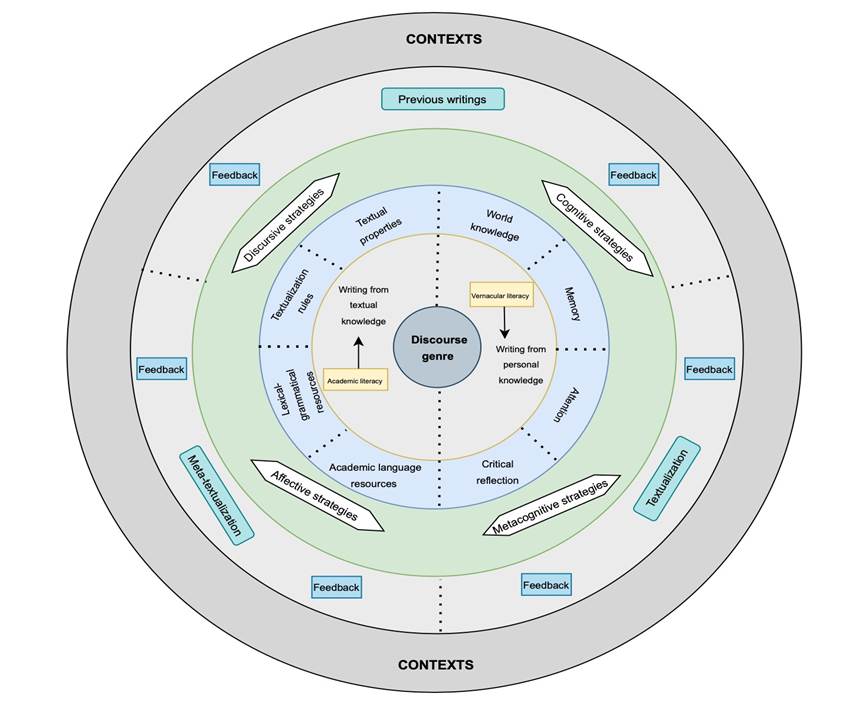
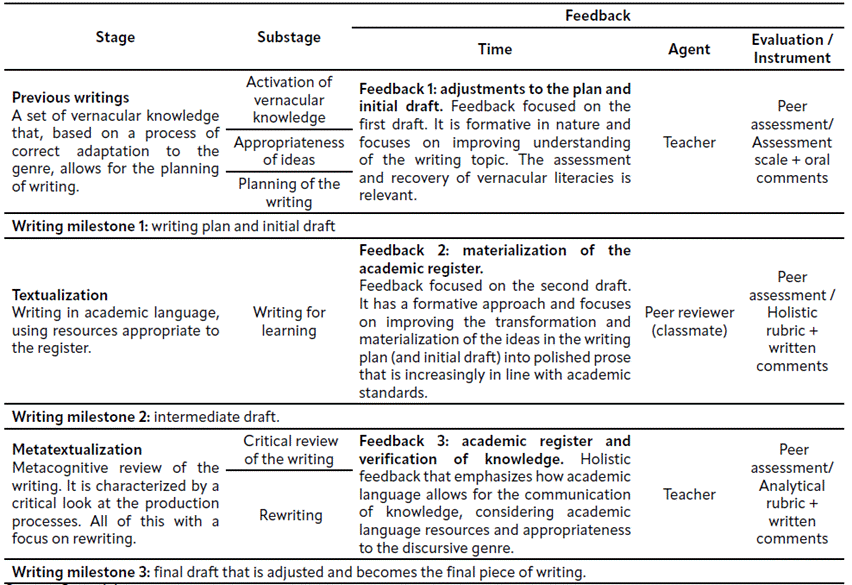
The model considers components of cognitive and sociocognitive constructs, as it emphasizes mental processes such as memory and attention, and specific knowledge such as vernacular writing and critical reflection. The central sphere positions discursive genre as the catalyst for textual action. In turn, it shares proximity, in the second dimension, with literacies, understood as reading and writing practices that are constantly complementary to other areas of knowledge: linguistics, psychology, anthropology (Lillis & Scott, 2007; Liébana, 2018). A relevant aspect of the model is the value placed on writing situated in informal spaces or outside the academic sphere, that is, vernacular literacies. We propose this as a new way of reading the world and an ideal space for understanding the mechanisms of processing and composing a piece of writing. It is a form of knowledge that has historically been separated from the academic register, yet it is a bearer of cultural identity and, potentially, of academic discursive identity. The third sphere emphasizes the linguistic aspects related to the mastery of an academic practice (rules, norms, properties, resources) as opposed to those that coexist with a more experiential vein (knowledge of the world, memory, attention, reflection). It should be noted that the dotted lines invite us to think of these latter components as mobile artifacts that are not limited to literacy, but rather were structured for an organization based on criteria that differentiate them from the purely linguistic-discursive. The fourth circle (green) brings together the strategies that are deployed throughout the process and stands as a result of the link between the elements of the previous circle, at the strategic component level. The fifth dimension specifies the phases of the writing process : (1) preliminary writing, understood as instances of access to knowledge, planning, information search, and data discrimination; (2) textualization, as the phase for capturing the ideas derived from the previous stage (simplified or extended); and (3) meta-textualization, conceived as an instance for thinking about language, reviewing the writing, and rewriting as necessary. It is important to clarify the consecutive and recursive nature of the stages. Likewise, the strong weight of feedback, both before and after the moments. The model has a coevaluative character, as students receive comments on adjustments derived from peer analysis.
Below is an explanatory notebook detailing the stages, sub-stages, and focus areas of feedback.
6. Conclusions
There is no doubt that writing in university classrooms, in different disciplines, departments, and areas of higher education, plays a crucial communicative role in the creation, transmission, and evaluation of learning. However, this process is often interrupted or hindered both by students' lack of knowledge about academic genres and by the practices of teachers who view this lack of knowledge with discomfort or who simply overlook the essential premise widely disseminated by theorists of writing pedagogy: writing is a process and, as such, requires a theoretical approach that allows students to decipher, replicate, and rework the complex framework that brings together the multiple areas of knowledge that contribute to the creation of a new text. These include, to name a few, the characteristics of the genre, language, context, subject matter, and the critical thinking skills required to evaluate the final product.
The proposed model, the result of theoretical knowledge, pedagogical dialogue, joint reflection, research, and teaching experience in university classrooms, presents writing from a sociolinguistic and co-evaluative approach, which places the student in an active role in the creation of their own learning and that of their peers, and the teacher as a guide who sets the time to be allocated to each of the stages of the teaching sequence (which will depend on the characteristics of the group and their level of progress in the task), in the activation of prior knowledge, the organization of ideas, the planning of writing and its revision, evaluation, and feedback.
The writing assessment proposal explained in these pages aims, based on the recovery of vernacular practices and critical reflection, to take a first step toward eradicating the widespread idea that university students do not know how to write and, therefore, represents a commitment to developing students' skills based on their previous formal and informal writing knowledge and experiences. However, it should be borne in mind that, compared to the frequent practice of reviewing only the final written product, this strategy requires more time to implement and greater effort on the part of the teacher in charge, as they will be responsible for creating specific assessment criteria and, based on these, providing progressive feedback that allows for the improvement of the writing. Likewise, students must assimilate a culture of co-evaluation, in which they will not only apply their knowledge of genre and language, but also, through the discursive form of commentary, tend toward a practice of critical writing.
As for the projections of this work, we hope to soon create a teaching proposal that validates the effectiveness of the model in real contexts. We also emphasize that it can be applied in secondary education, starting with work on cutting-edge academic genres that allow for the early development of writing skills.
Declaraciones
Authors' contributions Mauricio Castro-Cifuentes (author 1) Conceptualization - Formal analysis - Writing of the original draft - Revision and editing. Constanza Suazo-Muñoz (author 2) Conceptualization - Formal analysis - Writing of the original draft.
Conflicts of interest The authors declare that they have no conflicts of interest in relation to the preparation or publication of this article.
References
- Adler-Kassner, L., & Wardle, E. (2015). Naming what we know: Threshold concepts of writing studies. Utah State University Press.
- Alder, E. (2016). Becoming a student of English: Students’ experiences of transition into the first year. Arts & Humanities in Higher Education, 17(2),185-203.https://doi.org/10.1177/1474022216628303.
- Álvarez. T. y Ramírez, R. (2006). Teorías o modelos de producción de textos en la enseñanza y el aprendizaje de la escritura. Didáctica Lengua y Literatura, 18, 29-60.
- Andueza, A. (2019). Evaluación de la escritura académica: construcción y validación de un instrumento integrado basado en tareas para evaluar habilidades específicas de escritura. Relieve, 25(2), 1-17.https://doi.org/10.7203/relieve.25.2.11163.
- Ausubel, D., Novak J. y Henesian H. (1989). Psicología Educativa. Un punto de vista cognoscitivo. Trillas.
- Ávila, N., Navarro, F., Mónica, T. y Ortega, L. (2019). Voces desde adentro: Experiencias con escritura académica de estudiantes del programa PACE en tres universidades chilenas. Secretaría FONIDE, Centro de Estudios, Ministerio de Educación.
- Ávila, N., Calle-Arango, L., & Léniz, E. (2021). Researching in times of pandemic and social unrest: A flexible mindset for an enriched view on literacy. International Studies in Sociology of Education.https://doi.org/10.1080/09620214.2021.1927142.
- Ávila, N., Navarro, F., & Tapia-Ladino, M. (2020). Identidad, voz y agencia: Claves para una enseñanza inclusiva de la escritura en la universidad. Education Policy Analysis Archives, 28(89), 1-31.https://doi.org/10.14507/epaa.28.4722.
- Ávila, N. y Calle-Arango, L. (2022). Contextos, relaciones, escritores: hacia un modelo complejo del estudio y de la enseñanza de la escritura. Pensamiento Educativo. Revista de Investigación Educacional Latinoamericana, 59(2), 1-11.https://doi.org/10.7764/PEL.59.2.2022.1.
- Ávila, N., Espinoza, M., & Figueroa, J. (2021). Enseñanza del código escrito a estudiantes de segundo ciclo. Prácticas para Justicia Educacional, (13), 3-11.
- Ávila, N., González-Álvarez, P., y Peñaloza, C. (2013). Creación de un programa de escritura en una universidad chilena: estrategias para promover un cambio institucional. Revista Mexicana de Investigación Educativa, 18(57), 537-560.
- Bardine, B., Schmitz, M. & Deegan, E. (2000). Beyond the Red Pen: Clarifying Our Role in the Response Process. The English Journal 90(1), 94-101.
- Bazerman, C. (2017). Equidad significa participar plenamente en la conversación. Lenguas Modernas, (50), 33-46,https://lenguasmodernas.uchile.cl/index.php/LM/article/view/49249.
- Bazerman, C., Little, J., Bethel, L., Chavkin, T., Fouquette, D., & Garufis, J. (2016). Escribir a través del Currículum. Una guía de referencia. Universidad Nacional de Córdoba.
- Benítez, R. (2005). Teorías de la producción escrita. Internalismo y externalismo. Frasis Editores.
- Brandt, D. (2004). Literacy in American lives. Cambridge University Press.
- Cáceres, D., y Villamil, G. (2013). Estrategias didácticas para fomentar la lectura crítica desde la perspectiva de la transversalidad. REICE. Revista Iberoamericana sobre Calidad, Eficacia y Cambio en Educación, 11(3), 79-109.
- Camps, A. & Castelló, M. (2013). La escritura académica en la universidad. Revista de Docencia Universitaria, 11(1). 17-36.
- Carlino, P. (2004). Escribir a través del currículum: tres modelos para hacerlo en la universidad. Lectura y vida, (1), 16-27.
- Carroll, L. A. (2003). Rehearsing new roles: How college students develop as writers. Southern Illinois University Press.
- Cassany, D. (1988). Describir el escribir. Barcelona: Paidós.
- Cassany, D. (2008). Describir el escribir. Anagrama.
- Cassany, D. (2009). Reparar la escritura. Didáctica de la corrección de lo escrito. Graó.
- Cassany, D. (2021). El arte de dar clases: según un lingüista. Anagrama.
- Castelló, M. (2002). De la investigación sobre el proceso de composición a la enseñanza de la escritura. Signos, 35(51-52), 149-162.
- Cerda Canales, C. (2022). La transversalidad de la escritura en el currículum escolar chileno. REXE- Revista De Estudios Y Experiencias En Educación, 21(45), 108-122.https://doi.org/10.21703/0718-5162.v21.n45.2022.006.
- Corrigan, J.A. & Slomp, D.H. (2021). Articulating a Sociocognitive Construct of Writing Expertise for the Digital Age. The Journal of Writing Analytics (5).https://doi.org/10.37514/JWA-J.2021.5.1.05.
- Crespo, N. (1998). La evaluación de la escritura: Posibles criterios. Revista Signos, 31, 43-44.http://dx.doi.org/10.4067/S0718-09341998000100013.
- Díaz-Barriga, A. (2012). Pensar en didáctica. Colección Agenda Educativa.
- Didactext, G. (2015). Nuevo marco para la producción de textos académicos. Didáctica. Lengua y Literatura, 27, 219-254.
- Eiras, M., Galván, C., Moragas, F., Navarro, F., Obregón, C., Pisano, A., Romagnoli, A., y Russel, G. (2018). Manual de lectura, escritura y oralidad académicas para ingresantes a la universidad. Uiversidad Nacional de Quilmes.
- Elliot, S., Hendry, H., Ayres, C., Blackman, K., Browning F., Colebrook, D., Cook, C., Coy, N. Hughes, J. Lilley, N., Newboult, D., Uche, O., Rickell, A., Rura, G., Wilson, H., & White, P. (2018). On the outside I’m smiling but inside I’m crying’: Communication successes and challenges for undergraduate academic writing. Journal of Further and Higher Education, 43(9), 1163-1180.
- Eodice, M., Geller, A., & Lerner, N. (2019). The power of personal connection for undergraduate student writers. Research in the Teaching of English, 53(4), 320-339.
- Ezcurra, A. M. (2011). Abandono estudiantil en educación superior. Hipótesis y conceptos. En Gluz, N. (Ed.), Admisión a la universidad y selectividad social. Cuando la democratización es más que un problema de "ingresos", (pp.23-62). Universidad Nacional de General Sarmiento.
- Flower, L., & Hayes, J. (1981). A cognitive process theory of writing. College Composition and Communication, 32, 365-387.
- Förster, C. (Ed). (2017). El poder de la evaluación en el aula. Ediciones UC.
- Grupo Didactext. (2003). Modelo sociocognitivo, pragmalingüístico y didáctico para la producción de textos escritos. Didáctica (Lengua y Literatura), (15), 77-104.
- Hattie J. & Timperley, H, (2007). The Power of Feedback. Review of Educational Research, 77(1), 81-112.
- Hayes, J. (1996). A new framework for understanding cognition and affect in writing. In Indrisano R. & Squire J. R. (Eds.), Perspectives on writing: Research, theory, and practice, pp.6-44. International Reading Association.
- Hendrickson, J. (1980). The Treatment of Error in Written Work. Modern Language Journal, 64(2), 216-21.
- Liébana, J. (2018). La literacidad en la perspectiva sociocultural. De Vygotsky a la psicología cultural y a la enseñanza diversificada. En Núñez, P. (Ed.), Literacidad y secuencias didácticas en la enseñanza de la lengua y la literatura pp.(41-55). Octaedro.
- Lea, M. R., & Street, B. V. (1998). Student writing in higher education: An academic literacies approach. Studies in Higher Education, 23, 157-172.
- Lillis, T. (2017). Resistir regímenes de evaluación en el estudio del escribir: hacia un imaginario enriquecido. Signo y Pensamiento, 36(71), 66-81.https://revistas.javeriana.edu.co/index.php/signoypensamiento/article/view/21092.
- Lillis, T. y Scott, M. (2007). Defining academic literacies research: issues of epistemology, ideology and strategy. Journal of Applied Linguistics, 4(1), 5-32.
- Marincovich, J. (2002). Enfoque de proceso en la producción de textos escritos, Revista Signos 35(51-52), 217-230.https://www.scielo.cl/scielo.php?script=sci_arttext&pid=S0718-09342002005100014.
- Miras, M., & Solé, I. (2007). La elaboración del conocimiento científico y académico. En Castelló M. (Ed.), Escribir y comunicarse en contextos científicos y académicos (pp.83-112). Graó.
- Nallaya, S. (2018). An exploration of how first year students are inducted into their discipline’s academic discourses. International Journal of Educational Research, 87, 57-66.
- Navarro, F., Ávila Reyes, N., Calle, L., & Cortés, A. M. (2020). Lectura, escritura y oralidad en perfiles de egreso de educación superior: Contrastes entre instituciones y carreras. Calidad en la Educación, 52, 170-204.
- Naroa, A., & Álvarez, M. (2019). Representaciones sociales de los estudiantes universitarios de grado sobre la escritura académica. Íkala, 24(1), 103-118.
- Navarro, F., Uribe, F., Lovera, P., & Sologuren, E. (2020). Encuentros con la escritura en el ingreso a la educación superior: Representaciones sociales de los estudiantes en seis áreas de conocimiento. Ibérica, 38, 75-98.
- O’Shea, S., Lysaght, P., Roberts, J., & Harwood, V. (2016). Shifting the blame in higher education - social inclusion and deficit discourses. Higher Education Research and Development, 35(2), 322- 336.https://doi.org/10.1080/07294360.2015.1087388.
- Parodi, G. (2003). Relaciones entre lectura y escritura: una perspectiva cognitiva discursiva. Bases teóricas y empíricas. Ediciones Universitarias de Valparaíso.
- Pei-Leng, K. (2014). An Analysis of Written Feedback on ESL Students’ Writing. Procedia - Social and Behavioral Sciences 123. 389-397.
- Popham, W. (2006). Needed: A dose of assessment literacy. Educational Leadership, 63, 84-85.
- Ribas, T. (2011). Evaluar en el área de Lengua y Literatura. En Ruiz, U. (Coord.), Didáctica de la Lengua Castellano y la Literatura pp.61-78). Graó.
- Rodríguez, J. (2020). Las operaciones cognitivas empleadas en la producción de textos académicos. Cuaderno de Pedagogía Universitaria, 17(33), 94-103.http://cuaderno.pucmm.edu.do.
- Rohman, G. (1965) Pre-writing: The stage of discovery in the writing process. College Composition and Communication, 16, 106-112.
- Serrano, S. (2014). La lectura, la escritura y el pensamiento. Función epistémica e implicaciones pedagógicas. Lenguaje, 42(1), 97-122.http://www.scielo.org.co/pdf/leng/v42n1/v42n1a05.pdf.
- Smit, R. (2012). Towards a clearer understanding of student disadvantage in higher education: Problematising deficit thinking. Higher Education Research and Development, 31(3), 369-380.https://doi.org/10.1080/072943 60.2011.634383.
- Sommers, N. (1982). Responding to Student Writing. College Composition and Communication 33(2),148-56.
- Sotomayor, C., Ávila, N. y Jéldrez, E. (Coord.). (2015). Rúbricas y otras herramientas para desarrollar la escritura en el aula. Centro de Investigación Avanzada en Educación. Universidad de Chile.
- Stiggins, R. (1991). Relevant classroom assessment training for teachers. Educational Measurement: Issues and Practices, 10(1), 7-12.
- Tapia-Ladino, M., Correa, R., y Arancibia, B. (2017). Retroalimentación con comentarios escritos de ajuste al género (CEAG) en el proceso de elaboración de tesis de programas de formación de profesores. Lenguas Modernas. (50), 175-192.https://lenguasmodernas.uchile.cl/index.php/LM/article/view/49257.
- Trigos-Carrillo, L. (2020). Community cultural wealth and literacy capital in Latin American. English Teaching: Practice and Critique, 19(1), 3-19.
- Valenzuela Muñoz, A. (2021). Desempeño escrito de los estudiantes de secundaria en Chile: una evaluación directa e indirecta de la escritura. Logos: Revista de Lingüística, Filosofía y Literatura, 32(1), 91-105.https://doi.org/10.15443/RL3206.
- Wardle, E. (2013). What is transfer? In Malenczyk R. (Ed.), A rhetoric for writing program administrators (pp.143-155). Parlor Press.
- Yancey, K. (1999). Looking back as we look forward: Historicizing writing assessment. College Composition and Communication, 50(3), 483-503.https://doi.org/10.2307/358862.
Notes
- The University Selection Test (PSU, for its Spanish name Prueba de Selección Universitaria) was administered from 2003 to 2019. The test included an item titled "text production indicators" that indirectly measured writing skills through the use of connectors and writing plans.