ABSTRACT
The main objective of this paper was to analyze the teaching practices of teachers and preservice teachers in the Religious Education program at the Catholic University of Temuco, an institution located in the Araucanía region. To this end, a qualitative methodological approach was adopted, conducting semi-structured interviews with the following key stakeholders involved in the program's practice process: students, faculty, coordinators, and faculty members at the educational establishments. Data analysis was conducted using grounded theory. Among the results obtained, the following five important emerging empirical-analytical categories were identified: 1) experience of articulation between the degree program and the educational center, 2) competencies and challenges in the training of students in practice, and 3) strengths of the practice model and 4) perception of its weaknesses and improvements. Finally, the research findings emphasize the importance of linking disciplinary training and pedagogical practice in the design and implementation of a contextualized classroom that facilitates learning, interreligious dialogue, and intercultural diversity.
KEYWORDS: Religion teachers; teacher initial formation; pedagogical reflection; interreligious dialogue; interculturalityand regional context
RESUMEN
El presente trabajo tuvo como objetivo principal analizar las experiencias de prácticas pedagógicas de los profesores y profesores en formación pertenecientes a la carrera de Pedagogía en Religión de la Universidad Católica de Temuco, institución inserta en la región de La Araucanía. Para ello se adaptó un enfoque metodológico cualitativo en el que se aplicaron entrevistas semi estructuradas a los siguientes actores claves involucrados en el proceso de práctica de la carrera: alumnos, académicos, coordinadores y profesores colaboradores de los centros de los establecimientos educativos. El análisis de la información se realizó desde la Teoría fundamentada (Grounded theory). Entre los resultados obtenidos, se destaca la obtención de 5 categorías empíricas-analíticas emergentes de importancia: 1) experiencia de articulación entre la carrera y el centro educativo, 2) competencias y desafíos en la formación de los estudiantes en práctica y 3) fortalezas del modelo de prácticas y 4) percepción sobre sus debilidades y mejoras. En las conclusiones de la investigación se enfatiza la importancia de vincular la formación disciplinar y la práctica pedagógica para el diseño y aplicación de una clase contextualizada, que posibilite los aprendizajes, el diálogo interreligioso y la diversidad intercultural.
PALABRAS CLAVE: Profesores de religión; formación inicial docente; reflexión pedagógica; diálogo interreligioso; interculturalidad y contexto regional
1.-Introduction
1.1.Problem statement and study objective
Research on pedagogical practices in educational establishments in the context of teacher training in the area of religion has been little explored at the national and Latin American level in general. However, in the international context, it is possible to identify some relevant background information regarding religious education in public and private schools, especially in the European and Asian contexts.
In Europe, studies on religious training and education have been conducted mainly in Sweden (Berglund, 2022), Spain (Olmos-Gómez et al. 2020), Poland (Milerski & Karwowski, 2023), Ireland (O'Farrell, 2023), the United Kingdom (Metcalfe et al., 2024), Finland (Putkonen & Poulter, 2023), and Austria (Kolb, 2023). Meanwhile, in Asia and Oceania, research has been conducted in Korea (Kim, 2018), the Philippines (Castillo & Sarmiento, 2022), Indonesia (Dami et al., 2023; Mukhibat et al., 2024), and Australia (Poncini, 2023). Within this framework, there is a recent and growing research trend in relation to religious education in educational establishments.
For Castillo and Sarmiento (2022), religious education is essential for young people in public and private schools. According to these authors, religious education prepares them to face daily and future challenges, promoting interreligious harmony in society and tolerance among individuals, social groups, and ethnic groups. (Metcalfe et al., 2014; Schweitzer et al., 2023). The above aspects point to the need for educators who link Christian teaching with the comprehensive education of students in the classroom. However, the initial training of religion teachers and their insertion into challenging educational environments is a field of study that has been little researched in Chile, considering that pedagogical specialization in this area at the national level is rather scarce (Episcopal Conference, 2020).
Thus, this article presents the results of a perception study on the pedagogical practice system in the Religion Education program at UC Temuco in the Araucanía Region. In particular, the objective was to analyze the perceptions of students, coordinators, collaborating teachers, and faculty regarding the pedagogical practice process of the program in educational establishments. To meet this objective, a qualitative methodology was chosen, integrating analytical tools from grounded theory (Carrero et al., 2012; Corbin and Strauss, 2015).
Finally, the contributions of the research can be systematized as follows: a) on the one hand, with regard to the analysis of the perceptions of the actors involved in the teaching practice process in an uncommon area, such as the teaching and learning of religion in educational establishments; and, b) on the other hand, as input for possible research on the process of pedagogical reflection carried out by students based on the Pedagogical Standards (MINEDUC, 2022) and under the Religion Subject Study Program (Episcopal Conference of Chile, 2020). In this sense, thinking about religious education also involves a systematic analysis of the teacher's work in the classroom, in order to establish actions that strengthen their pedagogical work within a framework of religious diversity and plurality (Angarita, 2023).
1.2.Study framework
1.2.1.Initial teacher training: pedagogical practices
The professional quality of teachers is the most relevant factor in improving education (University of Tarapacá, 2021). Under this premise, educational policies in recent years have focused attention on both entry into Initial Teacher Training (ITT, FID in Spanish) and professional development. Thus, Law No. 20,903 in the area of ITT establishes the obligation to have Pedagogical and Disciplinary Standards for pedagogy programs. Likewise, the National Accreditation Commission (CNA) in Law 20,129 requires various aspects related to ITT practices as part of the accreditation criteria for pedagogy degrees.
Practical training in ITT is a key curricular space for learning how to teach and acquiring pedagogical knowledge for teachers in training (Tardif, 2010; Ripoll et al., 2021). Likewise, Tagle (2011) and Rivero et al. (2019) argue that students’ practical experiences play a significant role in the process of learning to teach, as they are regarded as a primary source of professional knowledge.
For his part, Domingo (2013) states that internships are all those specific experiences arranged as part of the university training process. In contrast, the practicum, being broader than internships, encompasses the entire training space considered as a reference for future professional practice, serving as a coordinating axis for the training processes of ITT (Ponce & Camus, 2019). According to López (2008), the practicum aims to facilitate the articulation between theory and practice and to provide future professionals with the tools, resources, and training necessary for their subsequent entry into the world of work.
For Zabalza (2017), the practicum is a curricular resource that must be approached from a threefold perspective: as a curricular component; as a learning opportunity; and as an opportunity for personal development. This initiation requires the necessary support of a collaborating teacher and a practicum course teacher (Agreda & Pérez, 2020; Torres et al., 2021). San Martín et al. (2021) consider that pedagogical support is key, not only as a means of consolidating the training received in higher education, but also for the construction of teaching identity.
In line with the above, the Ministry of Education in Chile has expressed its interest in promoting reflection at the level of initial training (Pedagogical Standards) and at the level of in-service teachers (Framework for Good Teaching, hereafter FGT) (MINEDUC, 2021, 2022). For Lorenzo and Calla (2024), teacher reflection is the basis for the construction of new knowledge. According to Domingo (2021), reflective practice is based on a) experience as a source of acquired knowledge; b) the professional setting in which knowledge is applied and teaching skills are activated; and c) reflection as an articulating element between theory and practice that leads participants to be active subjects in their training.
Likewise, various authors have proposed theories that level reflective thinking, from Van Manen (1977); Zeichner and Liston (1996); Jay and Johnson (2002) Larrivee (2008); Farrell (2016), to Díaz (2021). This leveling is shown in the following table.
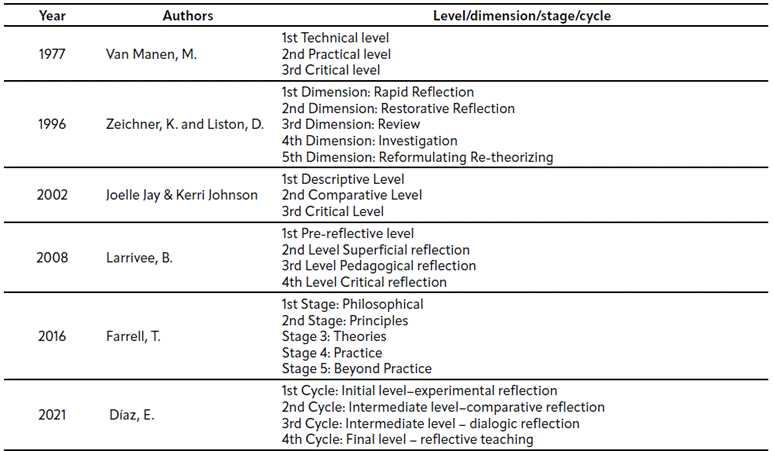
According to the table, reflective practice allows trainee teachers to construct knowledge by solving problems encountered in their work. In religious education, it also involves spiritual reflection on the meaning and purpose of their educational work.
1.2.2.Pedagogical practices in the initial training of religion teachers
Thinking about religious education involves conducting an in-depth analysis of the work of teachers in the classroom in order to establish actions that strengthen and guide their pedagogical work in the midst of religious plurality and current social secularization (Angarita, 2023). In this context, the practice of initial training for religion teachers constitutes a link between theological discipline and pedagogy, between the spiritual dimension and the school educational context. It integrates dimensions such as the construction of teacher identity, critical reflection on teaching, and the appropriation of the role of educator within the framework of School Religious Education (ERE).
According to Hernández and Quezada (2015), practical training allows students to gradually approach professional work and, at the same time, facilitates the construction and internalization of the teaching role. In addition, Hernández et al. (2016) point out that students say that professional practice allows them to strengthen their vocation, understand the complexity of the teaching profession, and the considerable challenge of being a religion teacher in an educational community.
The coherence between the message and action of the religion teacher in the evangelizing mission of the Church is highly relevant. In this space of professional practice, only some students are able to discover that the testimony required in the school system necessarily implies a response in the way of being and exercising a certain pedagogical function (Hernández et al., 2016). For his part, Alva (2018) argues that the teaching of religion is linked to witness, to consistency of life, and to a vocation of service. Therefore, teaching practice must also be a space for reflection and ethical-vocational discernment for future religion teachers.
In Latin America, religious education teachers generally need better professional training to help them develop teaching strategies and new skills for religious education, so that they can perform better in response to the needs of the educational community (Guerrero, 2020). Critical reflective processes in the pedagogical practices of ITT become opportunities to generate changes in strengthening the teaching profession of the Religion Teacher.
1.2.3.Pedagogical practices at the Faculty of Education of UC Temuco and the degree program in Religious Education
The practices of the Faculty of Education at UC Temuco are regulated internally by the Educational Model (Orrego et al., 2024), the Practice Model (UC Temuco, 2021), the Evaluation Model (UC Temuco, 2023), and Academic ViceRector's Resolution No. 69 (UC Temuco, 2024). The Practice Model defines teaching practices as a structured training experience that brings together the didactic, disciplinary, pedagogical, ethical, and moral knowledge provided for in the different study plans (UC Temuco, 2021). Likewise, this model establishes an ideal framework for the development of this formative experience called practicum, defined as the professional learning space for teachers/educators in training, carried out in formal or non-formal education centers.
During their training, students of Religious Education undertake internships in denominational and nondenominational primary and secondary schools. In these settings, they observe the context, gather information, and analyze it as a whole, with a particular focus on religion classes. These actions reflect the identity of the degree program, which focuses on promoting learning in intercultural and interreligious environments through theological and pedagogical reflection (Cifuentes et al., 2019).
The Faculty's Practice Model adopts the various theoretical orientations of reflection, Larrivee (2008), Van Manen (1977), Schön (1998), Jay and Johnson (2002), and Korthagen (1985). In this way, reflection is conceived as a strategy for professional progress that gives future teachers/educators the opportunity to perfect their pedagogical actions in the educational context, with the aim of enabling their students to construct quality learning (UC Temuco, 2021).
The actors identified by the Practice Model form a Formative Triad, consisting of the student, the practice course teacher, and the collaborating teacher at the practice center. The Triad promotes: a) The internalization of a model of professional and cultural behavior in the student; b) The pedagogical reflection of the student in practice, guided and provided with feedback by both teachers; and c) The construction of collaborative knowledge (Hernández and Quezada, 2016; UC Temuco, 2021).
The Practice Model details different strategies that guide pedagogical reflection, such as critical episodes, video observation, practical argumentation, action research, and the Korthagen reflection cycle. Korthagen's Reflection Cycle (2001) is organized into five phases identified by the acronym ALACT (Action, Looking back to the action, Awareness of essential aspects, Creating alternative methods of action, and Trial):
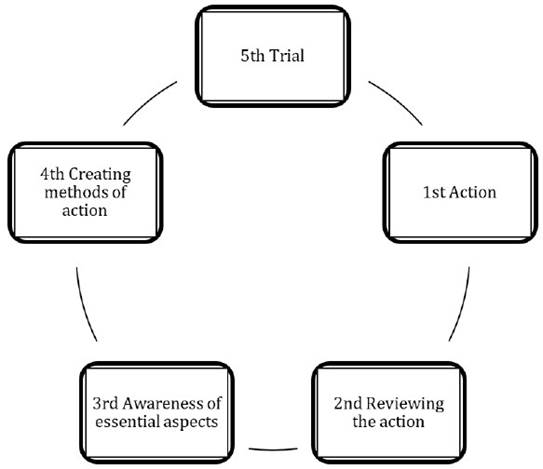
The basis of this model is observation of one's own performance, hence its importance for restructuring and improving teaching practices (UC Temuco, 2021).
2.-Methodological design
2.1.Methodological approach
A qualitative methodological approach was chosen to analyze the perceptions of the various actors involved in the model and process of practices in the Religious Education degree program. This methodology is based on the interpretation of individual actions and experiences (Valles, 2002). From this approach, the task of the social scientist is to understand, interpret, and analyze the subjective meaning behind individual action, seen in the context in which it occurs (Flores, 2009).
From a qualitative approach, it is established that organizations, institutions, and other social systems are the result of a set of deliberate, intentional, and meaningful actions and interactions carried out by various actors in relation to other actors in their daily lives (Edmonds and Kennedy, 2017). Theories that support the adoption of a qualitative approach to the study of subjects' actions and experiences in their daily lives include Weberian social action theory, hermeneutics, phenomenology, and symbolic interactionism (Flores, 2009; Valles, 2002).
Consequently, this approach has been chosen for the analysis of the perceptions of the various actors involved in the process of teaching practices in the Religion Education degree program.
2.2.Study participants
Given that interpretive theories emphasize that interactions in everyday life can have different meanings for the subjects involved, the study participants correspond to the following types of actors linked to the Model of Pedagogical Practices in Religious Education:
Practicum students (PS): students who have completed and passed the initial, intermediate, and final practicum cycles.
Practical training coordinators (Coord.): these are academics from the degree program who are responsible for managing the link between the program and educational establishments. They monitor students in practical training at selected schools.
Collaborating teachers (CT): these are the teachers who are employed by the practice centers. They are the ones with whom the student teacher interacts directly in the classroom and who observe how they prepare and teach a religion class to students at a certain level of education.
Practical course teachers (PCP): these are the academics in charge of the practical course for the degree program. They are responsible for ensuring the theological and pedagogical foundation that the PS must reflect in the design and execution of a class in the educational establishment.
2.3.Information gathering
To meet the study's objective, eight semi-structured interviews were conducted with the aforementioned actors. A semi-structured interview consists of a set of questions and aspects to be explored in relation to the research objectives, but neither the wording is fully structured nor do the questions follow a predetermined order. Thus, in this type of instrument, there is no fully structured questionnaire to which the interviewer must adhere; rather, there are questions and reference points for the objectives and questions that guide the study (Flores, 2009; Valles, 2002).
Consequently, the design of the semi-structured interview guideline applied was carried out considering the following thematic axes:
Introductory questions
Characteristics of the internship system in the degree program.
Roles and activities in the career practice process.
Experience of coordination with the educational center.
Student competencies and pedagogical standards.
Summary questions.
2.4.Information analysis plan
The plan for analyzing the qualitative information collected was based on the interpretive-explanatory categorization protocol of grounded theory. Grounded theory, developed by Glaser and Strauss (1967), is based on a form of theory construction based on the data collected. This emerging theory is compared with the evidence that has emerged through the constant comparative method (Corbin and Strauss, 2015). This method seeks to construct categories and their relationships based on the analysis of incidents such as text, audio, and video quotes, among others (Carreto et al., 2012).
According to Corbin and Strauss (2015), grounded theory must (a) fit the phenomenon; (b) provide understanding; and (c) provide generality, in the sense that the emerging theory is sufficiently abstract and empirical to be applicable to a variety of contexts. Thus, the analysis process comprised the following phases (Carrero et al., 2012):
Transcription and anonymization of the semi-structured interviews conducted.
Storage of information in a hermeneutic unit (HU).
Identification and segmentation of incidents and their categorization: comparison of each incident and assignment of as many categories as necessary. This phase corresponds to open coding.
Comparison of identified incidents, recoding of categories, and creation of new ones. This phase corresponds to axial coding and responds to a conceptual refinement of the information collected.
Theoretical conceptualization, in which the main categories of analysis, subcategories (properties), and incidents (textual citations) are established. This corresponds to the selective coding phase, and their relationships are realized.
Presentation and writing of the conceptual networks developed and their link to an integrated theoretical explanation in relation to the research objective.
Finally, it should be noted that the storage and processing of information was carried out using Atlas.Ti analysis software from the CAQDAS (Computer-Aided Qualitative Data Analysis Software) family (Edmonds and Kennedy, 2017; Flores, 2009).
3.-Results
3.1.Experience of articulation between Religious Education and the Educational Center
The practical training that makes up the degree program is divided into three training cycles that are in line with the guidelines of the Faculty of Education, the Pedagogical Standards, and the FGT. These levels correspond to the initial, intermediate, and final practical training. In these cycles, students make a diagnosis and reflection on the context of the educational center and the needs of the students in the classroom. With this, students identify the critical components of the religion class and/or the aspects to be integrated into their own class design and implementation.
In terms of the articulation experience with the practice center, it should be noted that the program has a constant link with the establishments, thanks to the dialogue it maintains with the Vicariate for Education and the La Araucanía Teachers' Foundation (FMDA):
"The program maintains constant dialogue with the Vicariate and the Teachers' Foundation. There are previously identified practice centers..." (Coord. 1).
On the other hand, it is noteworthy that the articulation of the program with other programs-the students' programs of origin-is in constant dialogue. Teamwork is observed thanks to the efforts of the General Coordination of Practices of the Faculty of Education:
"I feel that there is teamwork, and that teamwork exists because there is a community of practice coordination..." (Coord. 1).
A relevant aspect of the practice of students of Religious Education is that they can have the experience expected within the framework of the Catholic School Religious Education Program (EREC):
"It is expected that in practice, students will be able to have an experience in the EREC program, that they will have that experience as a religion teacher and as a collaborating religion teacher with further training" (Coord. 2).
From the point of view of the CTs at the practice centers, the articulation of the degree program is also viewed positively, with mention also made of the training provided by the institution to future religion teachers:
"The articulation experience with the degree program has been excellent...because I did a lot of training with the Catholic University years ago..." (CT 1).
In addition to the above, the CTs positively highlight the relationship with the PS, noting their proactivity, willingness, and motivation to learn and do things, as well as their receptiveness to constructive criticism to improve the execution of classes:
"The coordination experience was positive; I would have liked to share more with her. I also remembered things from university, and she helped me consider ideas that she brought up. I would highlight the student's proactivity, willingness, and desire to learn and do things" (CT 2).
From the perspective of the PS, the articulation between the two degree programs, the original one and the one in Religious Education, stands out, at least in terms of class schedules:
"Between the two program heads, when I did my internship in religion, I also had an internship in primary education. They adjusted both schedules..." (PS 1).
From the point of view of the PCPs, as with the other actors interviewed, the experience was positive. It is also noted that several of the CTs at the practice centers are graduates of the program itself, having been recommended by the Vicariate for Education as teachers of excellence in religious education:
“I have had good experiences. The collaborating teachers we have worked with are our alumni...they are recommended by the Vicariate as excellent teachers of religion. We want our students to have internships with very good teachers...” (PCP 1).
Finally, PCPs value the feedback that CTs give to PSs, as well as providing the necessary space for them to develop their practical experience in the classroom:
"They give us feedback... and make recommendations for students in practice. They are very collaborative and provide the space for students to live their experience in class..." (PCP 2).
Thus, with regard to the experiences and challenges in articulation, the following systematization figure is presented:
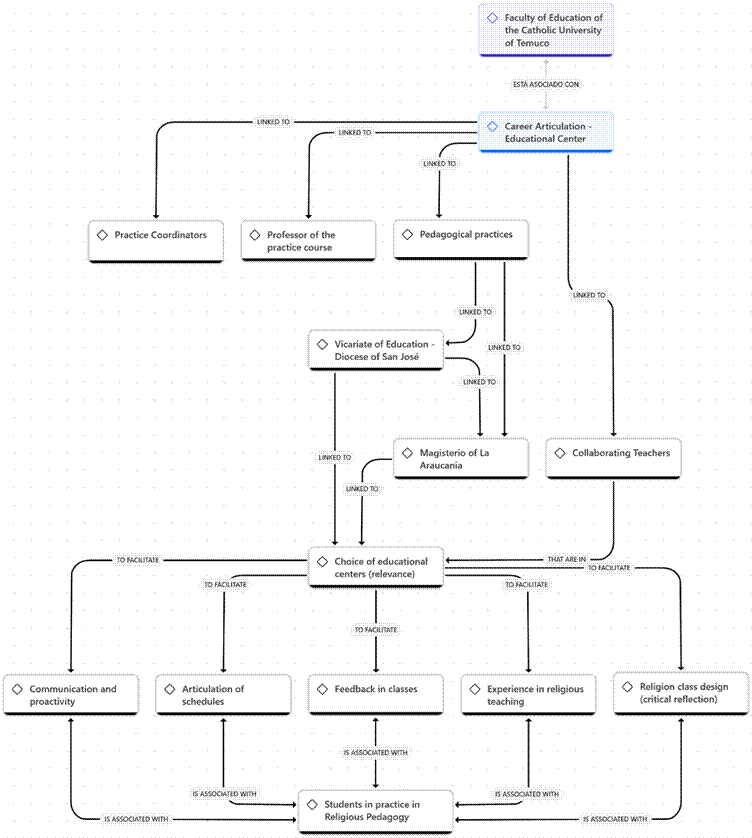
The coordinators highlight positive coordination with all the degree programs that make up the University's Faculty of Education, pointing to teamwork, respect, and appreciation of work as relevant hallmarks of coordination. On the other hand, in relation to articulation with practice centers, the coordinators interviewed highlight the support and practice of the Vicariate for Education and the FMDA. The practice is also based on the PS being able to directly implement and experience the guidelines of the EREC Program in the selected educational establishments.
The CTs highlight the coordination with the degree program and also value the feedback they provide on the work and reports prepared by the PS. On the other hand, the degree program is concerned with the selection of CTs with specialization and years of experience in Catholic religious education in educational establishments. For their part, the PSs highlight the flexibility of the degree program. Finally, the PCPs point out the positive coordination with the institution due to the support of the Vicariate for Education and the FMDA, respectively.
3.2.Competencies and challenges of training students in religious education
With regard to the competencies and challenges of student training, in practice it is expected that a process of pedagogical reflection based on the aforementioned standards and the FGT can be carried out:
"We approach pedagogical standards theoretically, in the first instance, and also when students submit their practice reports, they must refer to the pedagogical standards and the FGT in their reflection process" (Coord. 1).
In relation to the specific and generic competencies of the students, the CTs highlight in the first case the handling of disciplinary content for the final practice, while in the second area they emphasize the proactivity and sense of self-criticism that they present, although with some aspects to improve, such as group management skills in the classroom:
"Well, the strength, as I said, is the student's proactivity. However, in her case, she needed to work on her social skills, to be able to stand up in front of the class and control the group" (CT 2).
In the planning process, the student teachers show certain weaknesses in relation to consistency and writing between learning objectives and assessment indicators. In this sense, although the student teacher's disciplinary knowledge stands out, there is also a need to strengthen the operationalization between objectives, activities, and assessments:
"In the planning process, she had weaknesses, such as consistency between learning objectives and assessment indicators. It was as if she needed to work a lot on those elements for her planning..." (CT 2).
On the other hand, the testimonies of the teachers highlight that, in fact, the practice has always been based on the curriculum, using different domains present in the FGT:
"...we always worked according to the curriculum guidelines, both the teacher at school and at the university, we were always looking to use different domains of the MBE...There was a lot of co-teaching." (PS1).
This perspective is also complemented by the PCPs, who note that the training of religion teachers is aligned with the Faculty's Practice Model, Pedagogical Standards, and the FGT:
"We are aligned with general educational policy. We take reflection-pedagogical reflection-as the Faculty model, which is also present in the pedagogical standards and in the framework for good teaching..." (PCP 1).
Finally, the following figure presents a summary of the articulation between the training of religion teachers and the expected pedagogical competencies and standards:
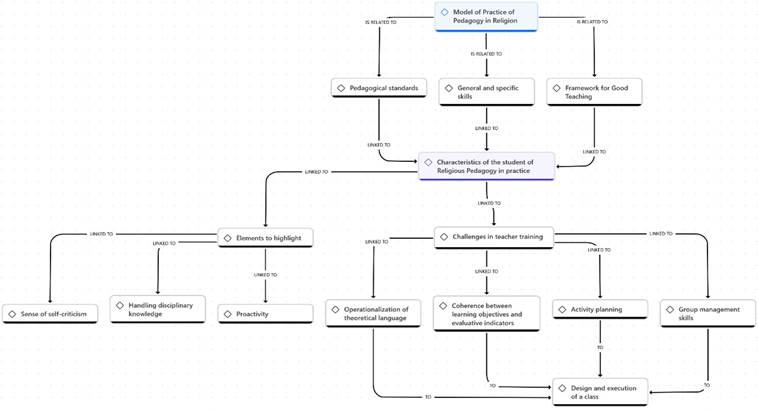
The interviewees positively value the articulation between student training, training in disciplinary content, and practice under the Pedagogical Standards and FGT and the Practice Model (seal) of the Faculty of Education.
Among the challenges related to the competencies presented by practice students, the following aspects are observed: 1) group management in the religion classroom; 2) management of critical situations in the classroom; 3) activity planning; and 4) the need to work intensively with students in the program on the operationalization of disciplinary content into objectives, activities, and assessments when planning and designing a class.
3.3.Strengths of the religious education teaching practice system
This section highlights, first and foremost, the level of connection that the degree program maintains with the collaborating teachers at the practice centers, as evidenced, for example, in the following quote from one of the interviewees:
"The greatest strength of the program's teaching practice system is its connection with the collaborating teachers..." (Coord. 1).
In addition to the above, the presentation, commitment, proactivity, and formality of the students are mentioned as positive and relevant aspects, along with the trust that the program has placed in the CTs:
"What I like is the formality, the personal presentation, and also the students' openness to suggestions. I also like the trust they have placed in my work..." (CT 1).
"I would highlight their commitment, which is greater than that of students in other internships because they already come with the organization of having two degrees. Their proactivity, their desire to do things..." (CT 2).
On the other hand, there is evidence of a constant concern on the part of the PCPs for the follow-up of the PSs in the establishments and the continuous contact they maintain with the students and the CTs:
"The concern of the professors in the program... I could see it with the professor who was constantly in contact and we talked about the student's strengths and weaknesses..." (CT 2)
"One of the most important strengths is the support we receive in practice..." (PS 1).
Another strength is related to the close link between the internship system and the EREC Program, as can be seen in the following quote from one of the interviewees:
"One strength is the use of the EREC Program.... Another is the teachers (collaborators), whom the program has taken great care to train..." (Coord. 2).
Mention is also made of the small number of students in the program, which facilitates their monitoring and reflection on the practical process they have experienced in the practice centers:
"Having small groups... The size of these groups facilitates the reflection process... (PCP 1).
The following figure presents a summary of the strengths identified in the program's pedagogical practice system:
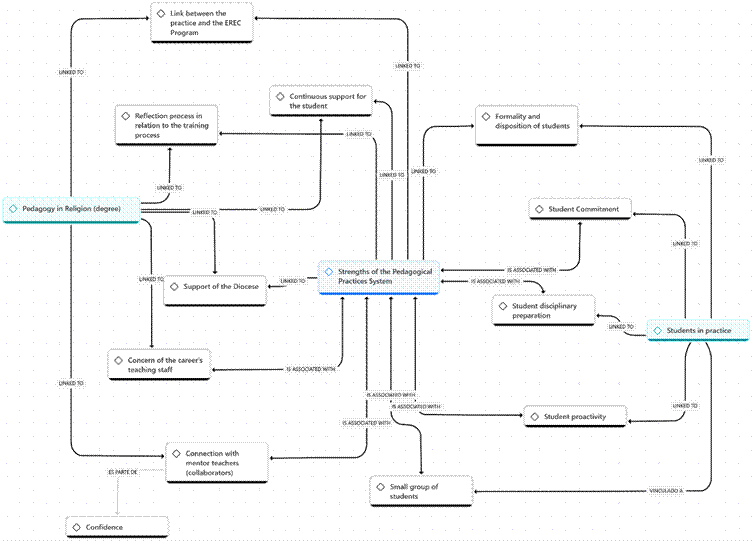
As can be seen, in the case of the degree program, the following categories related to the strengths of the internship model are evident: continuous student support, support and contact with the Vicariate for Education for teacher training, close links between the degree program and the CT of the establishments, the link between teaching practice and the EREC Program, and constant concern on the part of the academic team regarding the training process.
On the other hand, among the categories representing the strengths of the students, the following stand out: their formality and willingness, their level of commitment, their proactivity, and their disciplinary preparation in theological and pedagogical content.
3.4.Weaknesses and improvements to the teaching practice system in Religious Education
Regarding the weaknesses and suggestions presented by the teaching practice system of the degree program, the following representative categories have been obtained:
First, the need to strengthen the coordination between the Religion Education teaching practice coordinator and the CT of the practice center and greater knowledge of educational management on the part of the PSs, as well as greater skill in classroom group management and focused work with critical episodes:
"I think it is very important for students to start their teaching practice early and for the course teacher to be closely involved with the teacher collaborating with the student in training..." (Coord. 1).
"There is a shortcoming with regard to books, administrative work... What I have to accompany most- students in practice and beginning teachers-is how to deal with critical situations in the classroom..." (CT 1).
Secondly, it is emphasized that the degree program should pay greater attention to the didactics of assessment. In this sense, it is necessary for teacher educators to improve their class planning, seeking greater operationalization between disciplinary content, objectives, activities, and their didactics:
"I think assessment. That's a weakness that's difficult to address. Assessment in religion is something that isn't addressed much... There should be more focus on assessment and the teaching processes of planning..." (CT 2).
"Academics should have a greater understanding of the content, aimed at preparing students for their life in the classroom" (Coord. 2).
Another weakness highlighted is that teachers should have greater control over the group and also be better at handling critical situations in the classroom:
"A student comes to me and says, 'I've had a critical incident with a student and I have to call the parent, how do I do that?'... If they could work on that aspect with the students themselves... (CT 1)."
On the other hand, teacher educators mention the need to implement an initial assessment and not just a final assessment of the practicum:
"There is a lack of initial and final evaluation of the students in practice, although they are always with us." (EP 1).
This quote is also complemented by the PCPs in the program, which highlights the need to improve coordination with the TCs in the schools for a better joint evaluation of the PSs. This is evident in the following quote:
"Strengthen coordination with collaborating teachers to reflect together on the evaluation of our students..." (PCP 1).
The following conceptual network presents a summary of the main categories and suggestions for improving the system/model of teaching practices in the degree program:
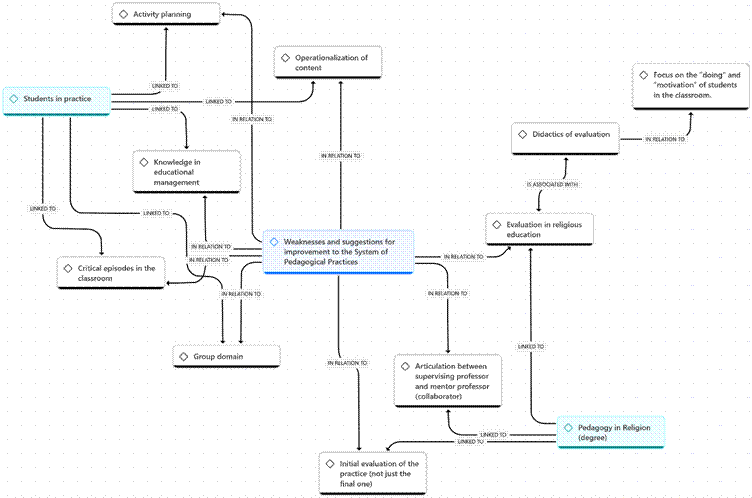
Thus, it can be seen that in the case of PSs, aspects related to group management and the handling of critical episodes in the classroom need to be improved, in addition to greater knowledge of educational management in schools. Along with this, there is a fundamental need to improve training in the operationalization of disciplinary knowledge for the design and execution of classes.
With regard to the degree program, the interviewees emphasize that training in assessment techniques in religious education for teacher trainees must be improved, together with greater coordination between the PCP coordinator and the CT at the practice center. Mention is also made of the need to implement an initial diagnostic assessment of teacher trainees to highlight possible progress throughout the practice process.
4.-Discussion
The main results of this study highlight the link between these practices and the guidelines of the Faculty of Education (Orrego et al., 2024; UC Temuco, 2021, 2023). It also reaffirms that this system of practices contributes significantly to the training of religion teachers. Finally, the interviewees positively highlighted elements such as: a) the authentic context; b) the Formative Triad; c) support; and d) cross-cutting and systematic pedagogical reflection.
The practical experiences of the degree program in authentic contexts, from the perspective of the practicum, allow students to learn about a real school environment in an experiential way (Torres, 2021). The richness of the practicum gives students the opportunity to learn to be religion teachers by learning to observe and problematize the experience in order to generate new knowledge (Zabalza, 2017).
The practical experience of the degree program also highlights the Formative Triad made up of the PS, PCP, and CT of the Practice Center. This Formative Triad promotes 1) the internalization of a model of professional and cultural behavior in the student teacher, 2) the pedagogical reflection of the student teacher guided and given feed back by both teachers, and 3) the construction of collaborative knowledge.
Thus, the third agent that makes up this Triad-the CT-is key to this practical experience. Both the PS and the PCP agree that the CTs stand out for their welcoming attitude, willingness, understanding, and openness to feedback on the PS' work. In this way, the practice is conceived as a privileged space for pedagogy students to acquire knowledge about teaching based on the knowledge constructed by a mentor teacher, that is, from their experiences, reflections, and representations (Tardif, 2010).
Religion teachers in the Formative Triade, with experience in the education system, are highlighted by student teachers for the effectiveness of their cross-curricular support for the teaching practice process, based on pedagogical reflection and the guidelines of the Pedagogical Standards (MINEDUC, 2022).
One of the challenges in the training of religion teachers in the degree program is the articulation of theological discipline and pedagogical practice for appropriate pedagogical design, with special attention to the evaluation of learning in a religion class in contexts of cultural and religious diversity. The support of the PCP and the CT is vital in the process of didactic transposition to ensure student learning (Agreda & Pérez, 2020; Mora, 2014).
Furthermore, attention to cultural and religious diversity is another major challenge in the training of religion teachers in the degree program. Inclusion is part of the Catholic identity, but in the context of Araucanía, we must ask ourselves: have our teachers identified gaps in intercultural and interreligious dialogue? Do they have sufficient knowledge of interculturality to facilitate the necessary dialogue for deep learning through religion classes?
5.-Conclusion
Initial teacher training faces constant demands and challenges. One of the challenges relates to the need to review the articulation-at the degree level with a special focus on practical training-of theology and pedagogy for the development of coherent and contextualized pedagogical designs, based on an adequate didactic transposition that generates meaningful and profound learning.
The second challenge is related to the effective preparation of future religion teachers to teach in contexts of cultural and religious diversity. Attention to diverse contexts is reflected in the institutional educational model and in the identity of the Religion Pedagogy degree program, in line with the Pedagogical Standards (MINEDUC, 2022). Therefore, the Formative Triad plays an important role in strengthening the identity of future teachers, in reflection processes, and in the generation of collaborative knowledge (UC Temuco, 2021).
One of the relevant findings in this study is related to the assessment of 'support' in practical processes. However, support is not clearly defined in the Practice Model (UC Temuco, 2021), and there are no guidelines for its implementation. Based on research and the experiences of students in practical training, accompaniment could consider two areas: a) consolidation of professional identity and b) deconstruction of pedagogical beliefs and construction of new knowledge for the transformation of practice.
The study opens up new areas of research, such as pedagogical reflection and its articulation with theological reflection in pedagogical practices, didactic transposition in the training of religion teachers, and the focus on religion and spirituality in teaching and learning for all students based on the approaches of the Curriculum Guidelines and the EREC Program.
With regard to the limitations of the study based on the Practice Model, it is possible to identify at least two limitations: a) Lack of guidelines for the operationalization of key areas in practical training, such as the Formative Triad and accompaniment processes from the perspective of the PCP and CT; and b) Generic definition of pedagogical reflection, a cross-cutting axis of practice.
Finally, this study, focused on pedagogical practices in the initial training of religion teachers, contributes to the regional and national context, allowing for a review of training processes to strengthen and pursue quality in the comprehensive training of religion teachers.
Acknowledgments
We would like to thank all the participants in this study for their willingness to share their experiences regarding practices and for their time. We would also like to thank the Faculty of Education at UC Temuco, as its training program in this area of practice facilitated this study.
Declaraciones
Contribution of the authors Hilda Jimena Fuentes Cid: Conceptualization - Formal analysis - Drafting of the original manuscript - Research - Supervision - Validation. Eduardo Alberto Arteaga Viveros: Conceptualization - Formal analysis - Methodology - Drafting of the original manuscript - Research
Conflicts of interest The authors declare that they have no conflicts of interest in relation to the preparation or publication of this article
Bibliographic references
- Alva, G. (2018). Educación religiosa y formación integral de los estudiantes del nivel secundaria de la institución educativa “Simón Bolívar”, Otuzco -2017. (Tesis Doctoral), Repositorio Universidad Cesar Vallejo.https://doi.org/10.37811/cl_rcm.v7i4.6955.
- Agreda, A. & Pérez, M. (2020). Relación entre acompañamiento pedagógico y práctica reflexiva docente. Espacios en Blanco. Revista de Educación, 2(30), 219-232.https://doi.org/10.37177/UNICEN/EB30-273.
- Angarita, Y. (2023). Educación Religiosa Escolar: un Constructo Teórico de la Praxis Docente Desde la Perspectiva de los Actores de Educación Secundaria. Ciencia Latina Revista Científica Multidisciplinar 7(4).https://doi.org/10.37811/cl_rcm.v7i4.6955.
- Astudillo, M., Nuñez, C. & Díaz, E. (2023).Progresión del Pensamiento Reflexivo Docente en la Formación Inicial: eje transformador de la Práctica Pedagógica y el desempeño profesional. Paideia, 71, 94 - 112.https://doi.org/10.29393/PA71-6PPME30006.
- Berglund, J. (2022). “Swedish Religion Education in Public Schools - Objective and Neutral or a Marination into Lutheran Protestantism?” Oxford Journal of Law and Religion 11 (1): 109-121.https://doi.org/10.1093/ojlr/rwac018.
- Carrero, V., Soriano, R., & Trinidad, A. (2012). Teoría Fundamentada Grounded Theory. El desarrollo de teoría desde la generalización conceptual. Serie Cuadernos Metodológicos, N°37, 2° Edición, revisada. Madrid, España.
- Cantero, D., San Martín, R., Pérez, S. & Bórquez, J. (2021). Prácticas de mejora para el proceso de acompañamiento pedagógico. Revista Electrónica "Actualidades Investigativas en Educación", 21 (2), 1-24, 2021.https://doi.org/10.15517/aie.v21i2.46783.
- Castillo, F., and Sarmiento, P. (2022). “A Systematic Review on Spiritual Modeling: Opportunities and Challenges in Religious Education.” International Journal of Christianity & Education 26 (1): 6-17.https://doi.org/10.1177/20569971211038968.
- Cifuentes, C., Navarro, J., Trujillo, P. & Garrido, S. (2019). Plan de estudios 2. Carrera Pedagogía en Religión. Facultad de Educación. UC Temuco.
- Corbin, J., & Strauss, G. (2015). Basics of qualitative research: techniques and procedures for developing grounded theory (4° ed). Sage, Thousand Oaks.
- Conferencia Episcopal de Chile (2020). Bases Curriculares y Programa de Estudio Asignatura de Religión. Área de Educación de la Conferencia Episcopal.
- Dami, A, Butarbutar, M., and Kusradi, S. (2023). “Two Different Models of Pedagogy: Rethinking Teachers’ Pedagogy Competency in Christian Religious Education.” International Journal of Christianity & Education 27 (2), 142-167.https://doi.org/10.1177/20569971221118075.
- Domingo, Á. (2021). La Práctica Reflexiva: un modelo transformador de la praxis docente. Zona Próxima, 34, 3-21.https://doi.org/10.14482/zp.34.370.71.
- Domingo, Á. (2013). Práctica reflexiva para docentes: De la reflexión ocasional a la reflexión metodológica. Revista de Docencia Universitaria, 11 (3), 491-492.http://dx.doi.org/10.4995/redu.2013.5542.
- Edmonds, A. & Kennedy, T. (2017). An Applied Guide to Research Designs. Quantitative, Qualitative and Mixed Methods. Second Edition. Sage.
- Flores, R. (2009). Observando observadores: una Introducción a las Técnicas Cualitativas de Investigación Social. Ediciones Universidad Católica de Chile.
- Guerrero, T. (2020). Educación valórica inclusiva y los desafíos de la educación religiosa para ser garante de tolerancia e inclusión social. Horizonte de la Ciencia, 10 (18).https://doi.org/10.26490/uncp.horizonteciencia.2020.18.431.
- Glaser, B., & Strauss, A. (1967). The discovery of grounded theory: Strategies for qualitative research. New York, Hawthorne.
- Hernández, M., & Quezada, A. (2015) El tutor de práctica en la formación de profesores de religión y filosofía. Revista Electrónica de Educación Religiosa, 5(1), 1-21.
- Hernández, M., Quezada, A. & Venegas, M. (2016). Análisis de la práctica docente en la formación inicial de profesores de religión. Educación y Educadores, 19(3), 357-369.https://doi.org/10.5294/edu.2016.19.3.3.
- Kim, C. Y. (2018). “A Critical Evaluation of Religious Education in Korea.” Religions 9 (11), 1-14.https://doi.org/10.3390/rel9110369.
- Kolb, J. (2023). “Muslim Diversity, Religious Formation and Islamic Religious Education. Everyday Practical Insights into Muslim Parents’ Concepts of Religious Education in Austria.” British Journal of Religious Education 45 (2), 172-185.https://doi.org/10.1080/01416200.2021.1911787.
- Lara, B., Barrientos, S. Díaz, G. (2017). Niveles y contenidos de las reflexiones pedagógicas de profesores de Educación Física. Educere, 21(68), 165-175.https://www.redalyc.org/journal/356/35652744015/html/.
- Ley 20.903, Crea el Sistema de Desarrollo Profesional Docente y modifica otras normas. 04 de marzo de 2016. Santiago, Chile. Recuperado en abril de 2025 en:https://bcn.cl/27gm2.
- Ley 20.129, Establece un sistema nacional de aseguramiento de la calidad de la educación superior. 17 de noviembre de 2006. Chile. Recuperado en abril de 2025 en:https://bcn.cl/2jvs7.
- López, M. (2008). Percepciones iniciales de los estudiantes sobre la formación práctica. Revista Iberoamericana de Educación, 47(5).https://doi.org/10.35362/rie4752268.
- Lorenzo, V. & Calla, W. (2024). Incidencia del saber pedagógico en la práctica reflexiva docente. Horizontes. Revista de Investigación en Ciencias de la Educación, 8 (33), 1022 - 1032.https://doi.org/10.33996/revistahorizontes.v8i33.780.
- Metcalfe, J., Kristjánsson, K., and Peterson, A. (2024). “Exploring Religious Education Teachers’ Perspectives on Character Development and Moral Virtues, in State-Funded, Non-Faith Schools in England.” Journal of Beliefs & Values 45 (4), 518-535.https://doi.org/10.1080/13617672.2023.2186644.
- MINEDUC (2022). Estándares Pedagógicos y Disciplinarios para Carreras de Pedagogía en Educación General Básica. Centro de Perfeccionamiento, Experimentación e Investigaciones Pedagógicas, Santiago. Chile.
- Milerski, B., and Karwowski M. (2023). “Educational Rationality and Religious Education in Polish Public Schools.” Journal of Beliefs & Values 44 (1), 81-98.https://doi.org/10.1080/13617672.2021.2018214.
- Mora, J. (2014). La transposición didáctica del saber del sabio al saber enseñado. autor Yves Chevallard. Revista Góndola, Enseñanza y Aprendizaje de las Ciencias, 9(2), 97-100.https://doi.org/10.14483/jour.gdla.2014.2.a07.
- Mukhibat, M., Efendi, M., Setyawan, W., and Sutoyo, M. (2024). “Development and Evaluation of Religious Moderation Education Curriculum at Higher Education in Indonesia.” Cogent Education 11 (1), 1-16.https://doi.org/10.1080/2331186X.2024.2302308.
- Olmos-Gómez, M., López-Cordero, R., García-Segura, S., and Ruiz-Garzón, F. (2020). “Adolescents’ Perception of Religious Education According to Religion and Gender in Spain.” Religions 11 (11), 1-13.https://doi.org/10.3390/rel11110616.
- O’Farrell, C. (2023). “Religious Education in the Early Years: An Irish Perspective.” Religions 14 (4), 1-10.https://doi.org/10.3390/rel14040459.
- Orrego, C., Palet, P., Bárcenas, J., Betancourt, O., Bustos, M. & Olavarría, A. (2024). Modelo Educativo UC Temuco. Temuco, Chile.
- Poncini, A. (2023). “Standards Setting in Religious Education: Addressing the Quality of Teaching and Assessment Practices.” Religions 14 (3), 1-14.https://doi.org/10.3390/rel14030315.
- Ponce, N., & Camus, P. (2019). La Práctica como eje Formativo-Reflexivo de la Formación Inicial Docente. Revista de Estudios y Experiencias en Educación, 18 (37), 113 - 128.https://dx.doi.org/10.21703/rexe.20191837ponce1.
- Putkonen, N., and Poulter, S. (2023). “Balancing Differences Through Highlighting the Common: Religious Education Teachers’ Perceptions of the Diversity of Islam in Islamic Religious Education in Finnish State Schools.” Religions 14 (8), 1-17.https://doi.org/10.3390/rel14081069.
- Ripoll, M., Palencia, P., & Cohen, J. (2021). Práctica pedagógica, un espacio de conceptualización y experimentación en la formación inicial del educador. Revista de Ciencias Sociales (Ve) XXVII (Especial 4), 351-363.
- Rivero, R., Arancibia, V., Claro, S., Lagos, F. & Hurtado, C. (2019). Organización de la formación práctica de futuros docentes de educación primaria en Chile: Estudio exploratorio desde las Universidades. Revista Calidad en la Educación, 50, 12-48.https://dx.doi.org/10.31619/caledu.n50.614.
- Schön, D. (1983). The reflective practitioner: how professionals think in action. Temple Smith.
- Schweitzer, F., Osbeck, C., Räsänen, A., Rutkowski, M., and Schnaufer, E. (2023). “Current Debates About (Inter-) Religious Literacy and Assessments of the Outcomes of Religious Education: Two Approaches to ReligionRelated Knowledge in Critical Review.” Journal of Beliefs & Values 44 (2), 254-266.https://doi.org/10.1080/13617672.2022.2099684.
- Tagle, T. (2011). El enfoque reflexivo en la formación docente. Calidad en la educación (34), 203-215.https://dx.doi.org/10.4067/S0718-45652011000100011.
- Tardif, M. (2010). Los saberes del docente y su desarrollo profesional. NARCEA S.A. DE EDICIONES.
- Torres, G., Simón, N., Domingo, L. & Amat, V. (2021). El prácticum en la formación inicial del maestro de primaria. Construyendo identidades docentes. Profesorado. Revista de Currículum y Formación de Profesorado, 26(2), 161-181.https://doi.org/10.30827/profesorado.v26i2.21599.
- UC Temuco (2023). Modelo Evaluativo. Facultad de Educación. Temuco, Chile.
- UC Temuco (2021). Modelo de Práctica. Facultad de Educación. Temuco, Chile.
- UC Temuco (2024). Resolución Vicerrectoría Académica N°64. Aprueba el Reglamento de Práctica de la Facultad de Educación. Chile.
- Universidad de Tarapacá (2021) Ley de Carrera Docente (20.903). Sistematización para docentes y estudiantes de carreras de pedagogía. Chile.
- Valles, M. (2002). Entrevistas cualitativas. Serie Cuadernos Metodológicos, N°32. Centro de Investigaciones Sociológicas (CIS). Madrid, España.
- Zabalza Beraza, M. A. (2017). El Practicum y las prácticas externas en la formación universitaria. Revista Practicum, 1(1).https://doi.org/10.24310/RevPracticumrep.v1i1.8254.
Notes
- Ethical implications There are no ethical implications to declare in the preparation or publication of this article.