ABSTRACT
Some studies report how the use of board games fosters the development of strategic skills and the construction of probabilistic knowledge. However, there has not yet been sufficient in-depth exploration of how these skills emerge and their potential for progression over time, particularly when implemented as part of intentional experiences aimed at educational innovation. In this context, the objective of the present study is to characterise the presence of strategic thinking and probabilistic thinking in university students engaged in decision-making processes while playing CATAN. To address this objective, six game sessions were conducted with six students from a Chilean university, all from non-mathematical disciplines and with no prior knowledge or experience of the game. These sessions included post-game interviews, which were analysed using Atlas.ti 25 software through a deductive content analysis approach. Based on specialised literature, the study establishes twelve analytical categories for probabilistic thinking and seven for strategic thinking. The study demonstrates the potential of using CATAN to promote the development of probabilistic and strategic thinking skills in non-formal education contexts.
KEYWORDS: Decision-making; probability; educational games; university students; informal learning
RESUMEN
Algunos estudios reportan cómo el uso de juegos de mesa favorece el desarrollo de habilidades estratégicas y la construcción de conocimiento probabilístico, sin embargo, aún no se ha profundizado de manera suficiente cómo surgen estas habilidades y sus posibilidades de progreso en el tiempo, especialmente cuando se implementan a partir de experiencias intencionadas para la innovación educativa. En esta línea, el objetivo del presente estudio es caracterizar la presencia de pensamiento estratégico y pensamiento probabilístico en el estudiantado universitario que enfrenta procesos de toma de decisiones al jugar CATAN. Para dar respuesta al objetivo, se realizaron seis sesiones de juego con seis estudiantes de una universidad chilena, pertenecientes a distintas carreras no matemáticas, con conocimientos nulos del juego e inexpertos en el mismo. Estas sesiones incluían entrevistas sobre las partidas, las que fueron analizadas usando el software Atlas.ti 25, a través de un análisis de contenido deductivo. Como marco conceptual se presentan, con base en la literatura especializada, doce categorías de análisis para el pensamiento probabilístico y siete para el pensamiento estratégico. El estudio demuestra el potencial del uso de CATAN para promover el desarrollo de habilidades del pensamiento probabilístico y estratégico en contextos de educación no formal.
PALABRAS CLAVE: Toma de decisiones; probabilidad; juego educativo; estudiante universitario; aprendizaje informal
1.-Introduction
Board games are a means of developing organizational and planning skills (Garcia & Torrijos, 2002; Victoria-Uribe et al., 2017), which is why learning through board games is found, to a greater extent, in classrooms (Arboleya García & Miralles, 2022; Inchingolo et al., 2023; Zheng et al., 2018), and is of particular interest in mathematics classrooms (Carmona & Cardeñoso, 2019). Although the usefulness of board games in different disciplines has been documented (Bayeck, 2020), much of the literature focuses on training artificial intelligence to optimize its performance in this type of game (Borges & Oliveira, 2021). With regard to students' mathematical learning, these games tend to be modified to adapt to the curriculum content, or they are often used as inspiration for the creation of new educational board games (Bakri et al., 2021; Lantarón et al., 2021; Nurhasanah et al., 2023).
A systematic review of the learning potential of board games in various settings, subjects, and students, conducted by Bayeck (2020), shows that, although there are several studies that have reported positive relationships between content learning and playing board games, the main focus has been on preschool and elementary school levels, and to a lesser extent secondary education, so there is no certainty as to whether this method is effective for the development of higher-order skills or abilities. Despite findings on how designing specific board games for education supports young people's learning, unmodified board games report similar results in the development of knowledge, skills, and competencies, without the effort involved in adapting them to the educational setting (Armstrong, 2020).
The literature reports how board games, even conventional ones, encourage creativity and stimulate interest in learning. The structure of these games leads players to face challenging situations that engage them, which promotes the development of their problem-solving skills (Assapun & Thummaphan, 2023). In addition, they are recognized as an innovative method for introducing mathematical knowledge (Maffia & Silva, 2022), as well as for developing mathematical skills, thinking, and reasoning, in addition to attitudes that value the role of mathematical knowledge (Morais et al., 2024). It is mainly for this reason that the use of board games is considered a tool to support classes, which is especially useful in improving students' learning in mathematics (Estrada-Plana et al., 2024).
In relation to strategic thinking, board games encourage participants to develop optimal tactics and evaluate the consequences of decision-making in contexts that mimic real-life conditions, such as cybersecurity, agrohydrology, agriculture, and war scenarios, as they express multiple, dynamic scenarios permeated by randomness (Kodalle et al., 2021; Orduña-Alegría et al., 2020; Shreeve et al., 2020).
The CATAN game has been studied from different perspectives. One example is the research conducted by Boda (2018), which examines the impact of players' emotions during the decision-making processes triggered by the game. Another example is the study by Dobre and Lascarides (2017), in which they use the CATAN game to evaluate a planning model for decision-making through the use of the Monte Carlo Search Tree algorithm and simulations of agents capable of handling a set of actions consistent with the rules of the game.
The study by Armstrong (2020) reports that playing CATAN promotes mathematical knowledge of probability in the curriculum. The researcher divides his sample into two groups, the first group studying with conventional curriculum material, while the second plays CATAN. When comparing the performance of both groups in two standardized probability assessments, higher scores were found among the group of students who played the board game rather than studying with the regular curriculum (Armstrong, 2020).
While Armstrong's (2020) study demonstrates CATAN's potential for developing probability skills in school settings, the study does not explore other possible mathematical connections that could arise from interaction with the game, beyond the content of probability. Furthermore, the focus is on probability as mathematical content, rather than probability as a skill or way of thinking, so it is still necessary to continue investigating the scope this game could have for the development of skills in more cross-cutting areas of mathematics. In this sense, probabilistic thinking is an area of interest, as it is a way of thinking that can facilitate decision-making in contexts of uncertainty (Vergara-Gómez et al., 2020). On the other hand, decision-making in situations of uncertainty requires the development of multiple skills and knowledge, as it is ubiquitous in everyday life (Vergara-Gómez, 2024). In this regard, strategic thinking also becomes relevant in the present study, due to the connection that authors such as Wild and Pfannkuch (1999) establish between strategic thinking and probabilistic thinking, as it favors the structural analysis of situations involving randomness.
Given the above, there are board games that have clear potential to promote the development of decisionmaking skills, the scope and effects of which have been little explored. This potential needs to be investigated, especially considering the enormous need to train young people to face complex problems, model uncertainty, and make informed decisions (Pfannkuch et al., 2016). Finally, although the literature has reported that board games can contribute to the study of mathematical learning and that it is not necessary to modify them or set them in a specific area to promote such learning (Armstrong, 2020; Bayeck, 2020), there are still few studies that address this mathematical learning from a didactic perspective, considering the possibility of developing concrete mathematical thinking oriented toward decision-making in contexts of uncertainty, whether in formal or nonformal educational contexts.
Therefore, in this study, we propose to characterize the presence of probabilistic thinking and strategic thinking in a group of young university students who face decision-making processes in the CATAN game. In particular, we decided to conduct the study with university students, as their legal age facilitates the ethical aspects of the research, as well as the management of an autonomous and informal learning space. To this end, an ethnographic approach is taken, involving the creation of a community of university players and monitoring the game over a period of six weeks through recordings and observations of the group of participants.
1.1.-Probabilistic Thinking
Probabilistic Thinking, hereafter referred to as PT, is culturally ingrained and manifests itself beyond school knowledge of probabilities; hence the importance of considering students' opinions to understand what may or may not work for them in terms of their probabilistic thinking (Sharma, 2014). In this way, people are able to interrogate, question, and discriminate conditions in probabilistic situations, constantly providing feedback on conclusions and their implications, which allows them to design, adapt, and classify their own strategies (Wild & Pfannkuch, 1999). PT corresponds to a set of skills closely linked to prediction and decision making (Estrella et al., 2024). Furthermore, its establishment and development allow people to assess risk in decision making in order to deal with situations of uncertainty (Batanero et al., 2023).
For his part, Borovcnik (2011) states that, although mathematicians agree that PT is defined by the ability to use probabilistic models, most people's perception of probability is influenced by context. Thus, Borovcnik (2011; 2016), as well as Batanero and Borovcnik (2016) in addition, define PT through the characteristics that affect people's perception in situations of uncertainty, such as the internalization of theory, temporal and timeless understanding of conditionality, or the importance of sample size, among others. Furthermore, along the same lines, it is clear that the understanding of the probability of events can be affected by the perception of surprise, variability, and independence of events or facts, as well as intuition and decision-making (Borovcnik, 2016).
Some of the key elements noted in relation to PT are related to the difficulties involved in empirically verifying a probabilistic hypothesis with little data, as well as the perception of risk and the influence of emotions on decision making under uncertainty (Batanero & Borovcnik, 2016; Borovcnik & Kapadia, 2018).
Taking the above into account, this study considers the purposes of probability established by Borovcnik (2016) as categories of analysis, together with some of the intuitive aspects that affect the perception of probability, defined as biases and heuristics by Batanero and Borovcnik (2016) (see Table 1).
![Table 1 Description of the categories of analysis of Probabilistic Thinking [PT].](https://rexe.cl/index.php/rexe/article/download/3302/version/4078/2545/13303/0718-5162-rexe-24-56-209-gt1.gif)
1.2.-Strategic thinking
In everyday life, people need to plan for the future and learn to act as necessary to achieve their goals and objectives. The set of skills that enable people to formulate a plan, implement it, and adapt to possible changes or obstacles are defined in Strategic Thinking (Bratianu & Murakawa, 2004), which we will refer to as ST from now on.
ST provides tools to analyze and evaluate information to identify potential risks, threats, and opportunities, and based on this description, it allows us to identify what is important when overcoming and dealing with challenges and, at the same time, completing goals and succeeding in the future (Watkins, 2024). This type of thinking encompasses the ability to anticipate potential obstacles and opportunities, consider different scenarios, develop step-by-step plans that are flexible and adaptable to unforeseen events, and efficiently use available resources to achieve the expected results (Arnanteerakul & Asanok, 2024).
A person with strategic thinking has a creative and skeptical profile that facilitates questioning the context, as well as being able to manage limitations in information (Wild & Pfannkuch, 1999). Another factor to consider in the development of ST is a person's values, as these become relevant when making decisions (Steptoe-Warren et al., 2011). In this way, values can have both a positive and negative impact, as they condition the strategist's field of vision, affecting their perception and interpretation of information and the decisions they make.
Arnanteerakul and Asanok (2024) describe ST as an indispensable element for facing the challenges of the 21st century. These authors use board games to study students' ability to make appropriate decisions and thus solve complex problems and challenges. Bratianu and Murakawa (2004) conclude something similar from a business perspective, noting that ST is an essential foundation for any organization seeking to grow sustainably and in complex contexts.
The characteristics of ST are defined in different ways or using different names. However, when analyzing the descriptions provided by different authors (Arnanteerakul & Asanok, 2024; Bratianu & Murakawa, 2004; Heracleous, 1998; South, 1981), their characterizations can be summarized in a common set, which allows us to organize the categories of analysis that will be used in this study (see Table 2):
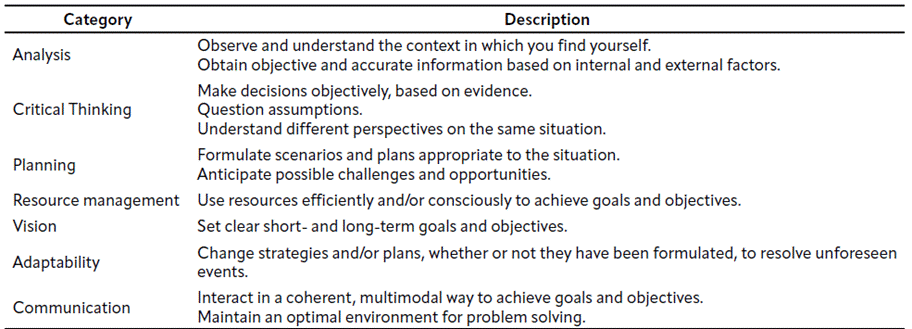
Note: Adapted and articulated from the following sources consulted: South (1981), Heracleous (1998), Bratianu and Murakawa (2004), and Arnanteerakul and Asanok (2024).
2.-Methodology
To carry out this research, a qualitative methodology with a deductive approach was used, which, as described by Urzola (2020), is a type of reasoning that starts from general premises to reach specific conclusions, allowing the formation of hypotheses based on established truths and postulates (p. 38). This method facilitates the reconstruction of theories based on inferences from observed data.
First, a form was designed using the "Google Forms" tool, with the purpose of inviting and recruiting potential participants. The questions on the form were aimed at gathering information about availability, career, and knowledge of the CATAN game, as well as explaining the research purpose of forming the club.
2.1. The CATAN game
Each player positions and builds villages and cities on a hexagonal board, which indicates and generates a specific raw material according to the values determined by the dice in each turn. With these resources, participants can trade with the bank or with each other, buy and use effect cards, expand, and build settlements. As an additional factor, each time the sum of the dice is 7, the "Thief" mechanic is used, which means that all players, including the one who rolled the dice, with 8 or more resource cards must discard half of their resources. The player who rolled the dice must then move the thief to a different space, which blocks the generation of resources in that space for those who have villages or cities in that space. Finally, the thief must randomly steal one of the resources from one of the players with villages or cities in the selected space. The game ends when a player reaches 10 victory points, which are obtained by building villages, cities, and roads, and purchasing development cards1 .
2.2. Context and participants
The study was conducted with university students from a university in south-central Chile. In response to the call for participants, 23 students expressed interest, but only 6 were selected. This selection was made for convenience, based on the availability of those who participated and in accordance with selection criteria (Otzen & Manterola, 2017). These criteria prioritized the participation of students from degree programs with a less mathematical profile and with partial or no knowledge of the CATAN game. Furthermore, the informed consent of the students was required, safeguarding all ethical aspects of the research.
2.3. Data collection techniques
To collect the data, a game workshop was implemented, in which the six volunteers, together with the researchers, played the CATAN board game. In this scenario, the researchers assumed the roles of both observers and participants (Gurdián-Fernández, 2007), as they were involved in the games as players, with the aim of contributing to the fluidity of the game and the learning curve of the participants. In each workshop session, two games are played simultaneously, each consisting of three participants and one researcher. The groups are formed randomly at the beginning of each session.
A total of six game sessions were held, one each week, lasting 30 to 90 minutes, in which one to two games were played per session, depending on time. In addition, semi-structured interviews were conducted at the end of each session to gain an in-depth understanding of the participants' voices (Corbetta, 2003). From these interviews, those of four participants were selected for analysis, as they were the ones who attended all the sessions.
2.4. Data analysis techniques
For the analysis of the data, a descriptive content analysis was performed using Atlas.ti 25 software for Windows, with the aim of identifying patterns through frequencies to interpret the findings (Dinçer, 2018). To this end, a code book was defined according to the categories of analysis defined in the conceptual framework (Table 1 and Table 2). Each of the descriptors formed a specific code. These categories and the respective descriptors allow us to understand from the discourse of the participants how PT and ST operate in decision-making associated with the CATAN game.
The units of analysis are made up of the responses given by the interviewees after each question and, in the case of outstanding findings, the complete video is used to clarify doubts and complement the analysis. The code book is presented in Table 3.
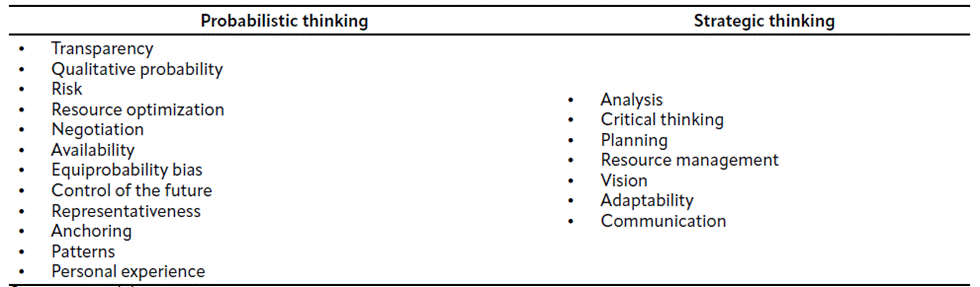
Each intervention by the interviewees is analyzed independently for each category. In this way, for each intervention, the possibility of assigning one of the 12 codes considered for PT and one of the 7 considered for ST was interpreted. This system allows us to identify and analyze the factors that influence the performance of the participants during the CATAN games, as well as the possible relationships between the types of thinking. For this last point, the co-occurrence tool of the Atlas. Ti software is used. The frequency of the codes for each type of thinking is counted, both independently and jointly, identifying and interpreting the patterns present in the responses. For the recording of the interviews, the responses of the main participants were labeled as E1, E2, E3, and E4. The rest of the students who intervene in a complementary manner in the responses are labeled as EX.
3.-Results
The most frequent categories are identified below, as well as the co-occurrences between PT and ST.
3.1. Analysis of category frequencies
The most frequent category in PT is Qualitative Probability, as most students, when justifying their position in the game, use colloquial probabilistic language to discriminate between the possible outcomes of rolling two dice. An example of this is E3, who responds in the second session interview to the question "Did you feel any noticeable change either in your way of playing or in the experience itself?
In this game, so to speak, I first identified, thanks to the previous games, which numbers in red were repeated the most (E3, session 2).
From the answer, it is possible to infer that E3 identifies regularities in the behavior of the dice, noting that the numbers 6 and 8-which are marked in red in the game-are the most likely to come up. Although this is valid in theoretical probability, E3 only justifies it based on the memory of previously obtained results, which refers to the bias of the representativeness of the PT.
Since the students constantly experimented with probability, they developed theoretical positions on the nondeterministic nature of the concept. An example of this is E2, who responds as follows in the sixth session interview to the question "What do you think about the distribution of numbers?
I think it's well distributed in general. It's just that there are games where, like this one, the 4 didn't come up at all, or in other games the 5 never comes up. It's like there's always a number that never comes up in a game, although it's never the same one (E2, session 6).
Interviewee E2 explains that, through the games he has played, he believes he has found a pattern in the frequency of the numbers that appear when rolling two dice, although he does not keep a formal record of the results. However, despite stating in the sixth session that he knows which numbers are theoretically most likely to appear and that the numbers 2 and 12 are the least likely to appear, he affirms that the maximum and minimum frequencies are not limited to these numbers alone. This belief coincides with the category of Representativeness, as it justifies a deterministic judgment about probability based on previous games.
The most prevalent category of ST is Resource Management, since the CATAN game is a strategy system based on the generation, exchange, and purchase of resources, so a simplified economy is built in each game that requires players to be aware of the materials they use. An example of this was E3's response in the fifth session interview to the question, "Is there anything from everyday life or economics that you have noticed in this game?"
It would be to take advantage of the situation, just as if we as players need to produce or collect materials of a certain type in order to advance, blocking that may be an opportunity for the other players (E3, session 5).
This response shows how E3 presents the ST Planning category, as they anticipate possible challenges and opportunities. It also shows that they analyze the conditions of the game in order to make optimal use of their resources, understanding the importance of the game context in complementing the development of strategies, which falls under the ST Analysis category.
An interesting finding is related to Communication, because although the rules of the CATAN game consider dialogue between players to be a fundamental part of the dynamics, due to the need to exchange resources, this is the ST category with the least presence in the interviews. This is because there are no clear indicators beyond stating that the more they play, the more confidence they have to talk to each other.
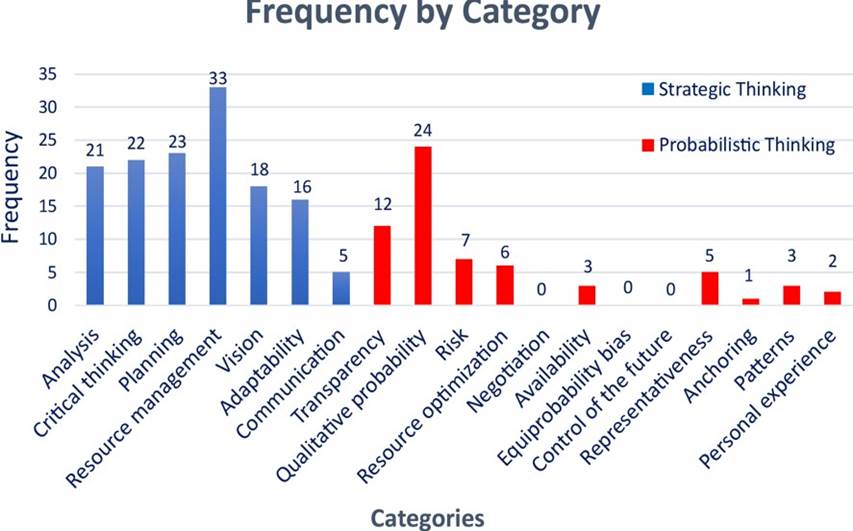
In summary, the frequency graph (Figure 1) reveals that, in the context of the game, Resource Management is the predominant category in both the ST and in general, with 16.6%. This is followed by Qualitative Probability with 12.1%, standing out as the main category in the PT, as students use colloquial language to refer to probabilities in the game. In contrast, Communication is the least frequent category in the ST, with only 2.5%. This is because, although the students interact effectively during the game, they only shed light on this category by pointing out how they gain confidence over time. On the other hand, in the PT, there are no responses associated with Future Control, Negotiation, or Equiprobability Bias, which reflects that the group of students, as they progress through the sessions, better understand the non-deterministic nature of probability when applying it in games.
3.2. Co-occurrence analysis of categories
In the context of the interview in the last session, participants are asked the question "What do you think about the distribution of numbers on the board?" E1 responds about the behavior of probability during the sessions and compares it with the theory.
The probabilities of the numbers coming up are very different from the probabilities, like, theoretical ones, like others, because there are numbers that should come up quite a lot and sometimes they don't. Today, the theoretical probabilities worked out pretty well; in that sense, today was a coincidence. But it's like that, it's very variable, the theory is not so applicable in terms of numbers, except for 6. I feel that 6 always remains more constant in all games (E1, session 6).
It can be seen that E1 analyzes the games that have been played up to the last session and shares his knowledge of probability, demonstrating that he understands the context in which he finds himself, and uses qualitative language when indicating that the observed probability of the dice is not equal to the theoretical probability, which allows us to classify his response in the Qualitative Probability category. However, E1 also demonstrates Representativeness by generalizing that one cannot rely on theoretical probability, since recent results have been highly variable in the dice rolls during the sessions they have played. In this statement, he mentions 6 as an exception, since, according to his most recent memories, it is a number that has remained constant in frequency over the weeks, which accounts for the presence of the PT category Availability.
In the same session, the group, with the exception of E3, faces a prepared starting scenario, positioning imaginary players in specific cells and numbers on the board. Figure 2 shows the scenario created for participants E1 and E4, on the one hand, and the game scenario created for E2, on the other.
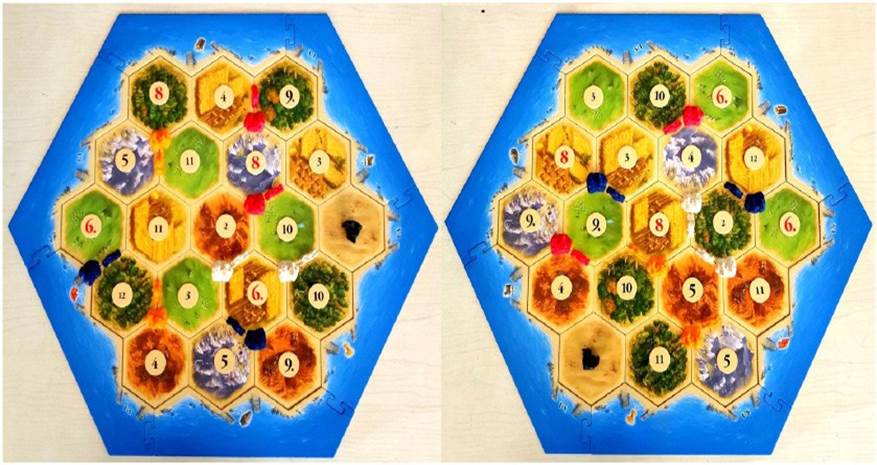
Figure 2 shows two different game starts, where the boards and player positions were arranged randomly, as is done when starting a real game. After giving them a moment to analyze, they were asked, "Which player on the board is most likely to win? And which player on the board is least likely to win?" The answers to these questions reveal a greater simultaneous occurrence of PT and ST, as strategic skills justified by probability are deployed.
In response to the first question, E1 demonstrates Critical Thinking and ST Planning, as he makes a decision based on the specific configurations of the boards presented to him, understanding the different perspectives and possibilities of each player and anticipating the opportunities and challenges of each one.
Perhaps red (...) is that, I don't know, I feel like it has slightly better numbers, the only number, like the one that loses a little more is 2 (...) (E1, Session 6).
Transparency of PT is evident when E1 justifies his decision to choose the player most likely to win based on the probability of the numbers he has. He explains this choice using colloquial language, thus also presenting Qualitative Probability. To justify this, it is noted that the player’s potential gains depend on a predominance of highly probable numbers.. He also acknowledges the possible losses that having the number 2 entails, thus demonstrating the Risk category of the PT.
When analyzing E1's response to the second question, the categories of Critical Thinking and Resource Management of the ST can be appreciated, as he critically evaluates his options based on the information provided by the board and emphasizes the importance of the opportunities offered by the availability of resources.
The target (...) is that it has very low numbers, 2 and 3, it loses a lot of clay (...). But it's still complicated because it could compensate for the clay with wheat, so if it manages to win the port, but it's a low probability considering that blue is also competing for the port (E1, session 6).
Resource Optimization, Risk, and Qualitative Probability, which belong to the PT, are evident in indicating ways in which resources can be used efficiently through probability, recognizing the risks of other players' possible strategies, and using qualitative language to describe the behavior of probability. In addition, E1 decided between the boards by explicitly supporting their analysis on probability, thus demonstrating the Transparency category.
Analyzing the answers given by E4 to the first question, Resource Management and Vision are observed, as they demonstrate awareness of the usefulness of the player's resources and use that information to set short- and longterm goals that justify their decision.
I would say blue because first, it has all the resources. Although it will have a problem with wood, it can solve it when the 6 or 9 appears, since it has a port here. Wheat could also be useful because there should be enough to build a city here along with stone and then improve trade with the port (E4, session 6).
The answer given by E4 shows planning skills, but also demonstrates progress in their understanding of probability theory, since, through resource optimization, they use probability to support their answer and analyze the possible challenges they will face during the simulated game, formulating scenarios to overcome the obstacles identified and take advantage of the opportunities they recognize in the player's resources.
As for the second question, the answer given by E4 demonstrates planning skills, as he is able to anticipate the challenges observed and formulate strategies that help him distinguish between the opportunities available to each player.
The orange tree is already orange because it is far from the ports, and then it would be white, but the white one can still trade wheat with the others; it may be the one that will predominate with wheat (E4, session 6).
Although E4 uses ST to assess the situation, which is manifested through Resource Management and Analysis, being aware of each player's assets, unlike the previous question, he does not use probability to complement his answer. This shows that, although E4 showed progress in probability theory, he only uses it circumstantially to argue his decisions. There are also signs of Negotiation in the PT, although E4 does not explicitly mention probability in their proposal.
E2, along with another group of students, faced a different situation than those analyzed by E1 and E4. In response to the first question, the category observed is Analysis in the ST, since it understands the situation based on external factors. In this way, it uses its experience with similar contexts witnessed in past games to understand the player's current possibilities.
If you complete that line, I think the white one. (...) is that something similar happened with what EX played recently, which took the longer route. And if he plays his cards right, I think the white one can win (E2, session 6).
As can be seen, E2 does not use probability to choose the player with the best chance of winning, as he places greater importance on securing points through game mechanisms that depend on the proximity and position of the populations in relation to his pieces and those of other players. In addition, E2's decision is based on a recent game.
Then, answering the second question, E2 evokes ST through Critical Thinking and Resource Management, and the PT through Resource Optimization and Transparency. This is because he makes decisions based on the low probability of the numbers in play and, according to this, he is aware of which are the best and worst resources. The use of probability allows him to discriminate more efficiently.
I say red, but because of the numbers it has. Because it has bad numbers, in theory; it only has the 6 that comes up most often (E2, session 6).
This answer shows that E2 has approached the theoretical probability of the results in a roll of two dice. However, unlike his previous answer, when deciding on the player with the worst chances, he gives greater importance to probability than to the strategies that may arise from his position. This may mean that the non-deterministic nature of probability causes students to consider the possibilities of the numbers to be less relevant than the position of their villages on the board, as long as the distribution of numbers on the board does not generate sectors of extreme probabilistic disparity.
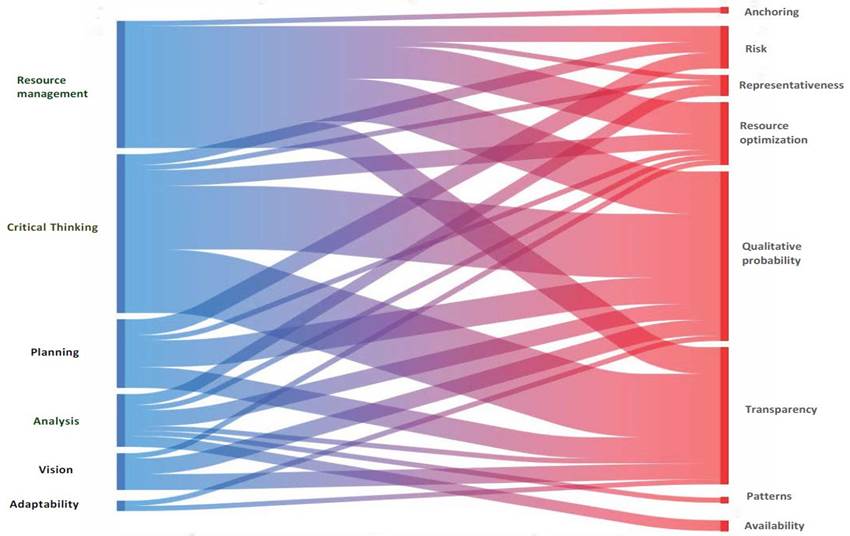
Figure 3 below presents a diagram that summarizes the co-occurrence between the PT and ST categories. The most frequent co-occurrences, in general, are Critical Thinking-Transparency and Critical Thinking-Qualitative Probability, with 12 interactions each. The first is due to the fact that both categories were instantiated by decisionmaking supported by data or evidence, with the difference that Transparency only considers probabilistic foundations, so they tend to appear simultaneously when students justify their moves based on probability. As for the second co-occurrence, this could be because, when explaining a decision, players resort to qualitative expressions about probability.
4.-Discussion and Conclusions
This research aimed to study the development of PT and ST and their possible relationships in decision-making through the CATAN game in non-formal educational contexts. To this end, the discourse of a group of students who participated in the workshop was analyzed, using interviews conducted at the end of each session as a data source. Based on the explanations and arguments, the presence of PT and ST was identified and classified according to previously defined categories. The educational experience associated with playing the game encouraged students to engage significantly with probability, conjecturing, questioning, and breaking down theoretical aspects. In addition, there was evidence of improvement in the use of the tools available in the game, as well as in the identification of obstacles and opportunities. Throughout the workshop sessions, the CATAN game emerged as an innovative tool for promoting spontaneous and experiential learning.
From the point of view of how the educational experience progressed, the data show a change in the students' perception of probability as they gained experience in the game. At the beginning, except for E1, the students did not know the theoretical probability of the results of rolling two dice. Then, over the course of the sessions, most of the students identified the most probable numbers, implicitly basing their strategies on clues from the theory, without any explanation from the researchers. In addition, the students gradually became more aware of the risk involved in the probability of the number 7, which causes half of the cards of each player with more than seven cards to be discarded. This result coincides with what was mentioned by both Maffia and Silva (2022) and Bayeck (2020) about how board games, and in this case CATAN, allow for the introduction of curricular content, such as mathematical knowledge about probabilities.
On the other hand, by the end of the sessions, the group realized that, no matter how probable some numbers may be, they cannot predict the outcome of the dice in a deterministic way, and this conclusion that allowed them to understand the unverifiable nature of probability through experimentation, coinciding with what was reported by Armstrong (2020) and Borovcnik (2016). However, the students do not downplay the importance of probability, as can be seen in the interviews. Although they prioritize position, diversity of resources, and choice of resources, they always consider the probability of the numbers to play, thus recognizing the value of mathematics in developing knowledge, as stated by Morais et al. (2024).
Although it is unlikely that students will encounter a situation similar to CATAN in real life, during the interviews they mention that, as they progress through the sessions, they think more critically and increasingly consider aspects that they must take into account when making decisions. In addition, they express that, throughout the games, they strengthened their level of goal achievement, developing strategies aimed at better leveraging the mechanics of the game. This is consistent with the findings of Kodalle et al. (2021), Orduña-Alegría et al. (2020), and Shreeve et al. (2020), who assert that this type of board game prepares players for scenarios similar to those presented in the games and/or for developing decision making and ST.
In the students' responses to the last interview, in which they were asked their opinion about which color was most likely to win, we can see what Assapun and Thummaphan (2023) say about problem solving, as they were able to analyze, evaluate risks and opportunities, make decisions, and plan a series of advantageous actions to win the game, taking into account not only their own moves but also anticipating their opponents' possible moves.
Finally, the results also highlight that the categories of Critical Thinking, Transparency, and Qualitative Probability were predominant in the students' responses. When faced with a random scenario prepared by the interviewing group, the students made decisions based implicitly on probability and used qualitative language to refer to it, which reaffirms that PT can favor decision making in contexts of uncertainty (Vergara-Gómez et al., 2020). In this way, the CATAN board game stands out as a resource that promotes innovation in the field of mathematics education.
As for the limitations of the study, data collection was restricted by the time available, the space provided, and the tools used to capture audiovisual material. Furthermore, the sample size was insufficient for generalization or external validity, so it is proposed that this study be conducted in other institutions and/or educational levels with larger samples. In addition, the findings of this study allow us to recommend that teachers use the game in the mathematics classroom to introduce and encourage probabilistic thinking, especially from a qualitative perspective. The dynamics of the game can be accompanied by guiding questions that allow students to delve deeper into how probabilistic thinking favors the development of winning strategies. We plan to expand this study to other types of mathematical thinking and other educational levels, evaluating the potential of the game for incorporation into different classroom contexts.
Declaraciones
Contribution of the authors Vincent Ganga-Cáceres: Problematization - State-of-the-art study - Conceptualization of probabilistic thinking - Initial proposal for methodological design - Organization and implementation of the workshop for data collection - Formal analysis - Drafting of the original manuscript. Eduardo Pérez-Gajardo: Problematization - State of the art study - Conceptualization Strategic Thinking - Initial methodological design proposal - Organization and implementation of the data collection workshop - Formal analysis - Methodology - Drafting of the original manuscript. Miguel Reyes Astorga: Conceptualization - State-of-the-art study - Probabilistic Thinking Conceptualization - Organization and implementation of the data collection workshop - Audio and video transcription - Data curation - Graph creation - Formal analysis - Drafting of the original manuscript. Andrea Vergara-Gómez: Research design - Initial proposal for categories of analysis - Adjustment of the methodological design and conceptual framework - Writing, review, and editing
Conflicts of interest The authors declare that they have no conflicts of interest in relation to the preparation or publication of this article
Acknowledgments
The authors would like to thank the Directorate of the School of Mathematics Education at the Universidad Católica del Maule for supporting this research initiative by facilitating access to spaces and time for the implementation of the workshop. We also thank the participating students for their willingness and commitment during the research.
References
- Arboleya-García, E., y Miralles, L. (2022). ‘The Game of the Sea’: An Interdisciplinary Educational Board Game on the Marine Environment and Ocean Awareness for Primary and Secondary Students. Education Sciences, 12(1), 57.https://doi.org/10.3390/educsci12010057.
- Armstrong, A. (2020). Playing Settlers of Catan Enhances Student Learning of Probability in Liberal Arts Mathematics. PRIMUS, 31(10), 1136-1148.https://doi.org/10.1080/10511970.2020.1818335.
- Arnanteerakul, A., y Asanok, M. (2024). Development of experiential learning model using board games to enhance strategic thinking for undergraduate students, Nanotechnology Perceptions, 20(S8), 807-820.https://doi.org/10.62441/nano-ntp.v20iS8.67.
- Assapun, S., y Thummaphan, P. (2023). Assessing the Effectiveness of Board Game-based Learning for Enhancing Problem-Solving Competency of Lower Secondary Students, International Journal of Instruction, 16(2), 511-532.https://doi.org/10.29333/iji.2023.16228a.
- Bakri, S.R.A., Liew, C.Y., Chen, C.K., Tuh, M.H., y Ling, S.C. (2021). Bridging the Gap Between the Derivatives and Graph Sketching in Calculus. Asian Journal of University Education, 16(4), 121-136.https://doi.org/10.24191/ajue.v16i4.11962.
- Batanero, C., y Borovcnik, M. (2016). Statistics and Probability in High School. SensePublishers.https://doi.org/10.1007/978-94-6300-624-8.
- Batanero, C., Gea, M.M., y Álvarez-Arroyo, R. (2023). Educação do raciocínio probabilístico. Educação Matemática Pesquisa Revista Do Programa De Estudos Pós-Graduados Em Educação Matemática, 25(2), 127-144.https://doi.org/10.23925/1983-3156.2023v25i2p127-144.
- Bayeck, R.Y. (2020). Examining Board Gameplay and Learning: A Multidisciplinary Review of Recent Research. Simulation & Gaming, 51(4), 411-431.https://doi.org/10.1177/1046878119901286.
- Boda, M.A. (2018). Avoiding Revenge Using Optimal Opponent Ranking Strategy in the Board Game Catan. International Journal of Gaming and Computer-Mediated Simulations (IJGCMS), 10(2), 47-70.https://doi.org/10.4018/IJGCMS.2018040103.
- Borges, A., y Oliveira, A. (2021). Combining off and on-policy training in model-based reinforcement learning. arXiv:2102.12194 Preimpresión.https://doi.org/10.48550/arXiv.2102.12194.
- Borovcnik, M. (2011). Strengthening the Role of Probability Within Statistics Curricula. Teaching Statistics in School Mathematics-Challenges for Teaching and Teacher Education (pp. 71-83).https://doi.org/10.1007/978-94-007-11310_11.
- Borovcnik, M. (2016). Probabilistic thinking and probability literacy in the context of risk. Educação Matemática Pesquisa Revista Do Programa De Estudos Pós-Graduados Em Educação Matemática, 18(3), 1491-1516.https://revistas.pucsp.br/index.php/emp/article/view/31495.
- Borovcnik, M., y Kapadia, R. (2018). Reasoning with Risk: Teaching Probability and Risk as Twin Concepts. Teaching and Learning Stochastics (pp. 3-22).https://doi.org/10.1007/978-3-319-72871-1_1.
- Bratianu, C., y Murakawa, H. (2004). Strategic thinking. Transactions of JWRI, 33(1), 79-89.https://doi.org/10.18910/10145.
- Carmona, E., y Cardeñoso, J.M. (2019). Situaciones basadas en juegos de mesa para atender la elaboración del conocimiento matemático escolar. Épsilon, 101, 7-30.
- Corbetta, P. (2015). La ricerca sociale: metodologia e tecniche: III. Le tecniche qualitative. Società editrice il Mulino.
- Dinçer, S. (2018). Content analysis in scientific research: Meta-analysis, meta-synthesis, and descriptive content análisis. Bartin University Journal of Faculty of Education, 7(1), 176-190.https://doi.org/10.14686/buefad.363159.
- Dobre, M.S., y Lascarides, A. (2017). Exploiting action categories in learning complex games. Intelligent Systems Conference (IntelliSys), Londres, 7 y 8 de septiembre, Nueva Jersey: IEEE. pp. 729-737.https://doi.org/10.1109/IntelliSys.2017.8324210.
- Estrada-Plana, V., Martínez-Escribano, A., Ros-Morente, A., Mayoral, M., Castro-Quintas, A., Vita-Barrull, N., TerésLleida, N., March-Llanes, J., Badia-Bafalluy, A., y Moya-Higueras, J. (2024). Benefits of Playing at School: Filler Board Games Improve Visuospatial Memory and Mathematical Skills. Brain Sciences, 14(7), 642.https://doi.org/10.3390/brainsci14070642.
- Estrella, S., Rifo, L., & Vergara, A. (2024). Explorando el pensamiento probabilístico en investigaciones recientes (2010-2022): dos momentos históricos epistemológicos y siete conceptos clave. En Estrella, S., Parraguez, M., y Olfos, R. (Eds.), Pensamiento Matemático: Aportes a la práctica docente desde la didáctica de la matemática. GRAO.
- Garcia, G., y Torrijos, E. (2002). Juegos de mesa. Quarzo.
- Gurdián-Fernandez, A. (2007). El Paradigma Cualitativo en la Investigación Socio-Educativa. Colección IDER, PrintCenter.https://hdl.handle.net/20.500.12799/4525.
- Heracleous, L. (2003). Strategic thinking or strategic planning?. Strategy and Organization, 38-52.https://doi.org/10.1017/cbo9780511615313.004.
- Inchingolo, G., Toniolo, R., Varano, S., Ligabue, A. y Ricciardi, S. (2023). PIXEL: Challenges of Designing a Professional Board Game for Astronomy Education. European Conference on Games Based Learning, 17(1), 278-288.https://doi.org/10.34190/ecgbl.17.1.1481.
- Kodalle, T., Schmidt, M., Thomas, W., y Metz, M. (2021). Gamification of Strategic Thinking: A COTS Boardgame for Learning Scrum, Strategy Development and Strategy Implementation. En Fotaris, P. (ed.), 15th European Conference on Games Based Learning (pp. 417-425). Academic Conferences and Publishing International Ltd.
- Lantarón, S., López, M., Merchán, S., y Rodrigo, J. (2021). Improving the Teaching of Real Valued Functions Using Serious Games. Binary Who Is Who? Mathematics, 9(11), 1239.https://doi.org/10.3390/math9111239.
- Maffia, A., y Silva, L. (2022). On the use of boardgames to develop young children’s number sense. Twelfth Congress of the European Society for Research in Mathematics Education (CERME12), Feb 2022, Bozen-Bolzano, Italia.https://hal.science/hal-03750245.
- Morais, A., Sousa, H., Aires, A.P., Cravino, J., y Lopes, J.B. (2024). Future teachers' perceptions towards incorporating board games to teach mathematical skills in History classes. International Journal of Instruction, 17(4), 557-572.https://doi.org/10.29333/iji.2024.17431a.
- Nurhasanah, F., Usodo, B., Sutopo, H.E., Kuswardi, Y., Setiawan, L., y Febrianti, T.S. (2023). Designing a family board games for teaching fractions based on theory of abstraction and multiple representation. The 3rd international conference on science, mathematics, environment, and education: Flexibility in Research and Innovation on Science, Mathematics, Environment, and Education for Sustainable Development, 2540, 070013.https://doi.org/10.1063/5.0105869.
- Orduña Alegría, M.E., Schütze, N., y Zipper, S.C. (2020). A Serious Board Game to Analyze Socio-Ecological Dynamics towards Collaboration in Agriculture. Sustainability, 12(13), 5301.https://doi.org/10.3390/su12135301.
- Otzen, T., y Manterola, C. (2017). Técnicas de Muestreo sobre una Población a Estudio. International Journal of Morphology, 35(2), 227-232.http://dx.doi.org/10.4067/S0717-95022017000100037.
- Pfannkuch, M., Budgett, S., Fewster, R., Fitch, M., Pattenwise, S., Wild, C., & Ziedins, I. (2016). Probability modeling and thinking: What can we learn from practice?. Statistics Education Research Journal, 15(2), 11-37.https://doi.org/10.52041/serj.v15i2.238.
- Sharma, S. (2014). Cultural Influences in Probabilistic Thinking. Probabilistic Thinking, 657-681.https://doi.org/10.1007/978-94-007-7155-0_35.
- Shreeve, B., Hallett, J., Edwards, M., Ramokapane, K.M., Atkins, R., y Rashid, A. (2022). The Best Laid Plans or Lack Thereof: Security Decision-Making of Different Stakeholder Groups. IEEE Transactions on Software Engineering, 48(5), 1515-1528.https://doi.org/10.1109/tse.2020.3023735.
- South, S.E. (1981). Competitive advantage: the cornerstone of strategic thinking. Journal of Business Strategy, 1(4), 15-25.https://doi.org/10.1108/eb038908.
- Steptoe‐Warren, G., Howat, D., y Hume, I. (2011). Strategic thinking and decision making: literature review. Journal of Strategy and Management, 4(3), 238-250.https://doi.org/10.1108/17554251111152261.
- Urzola, A. (2020). Métodos inductivo, deductivo y teoría de la pedagogía crítica. Revista Crítica Transdisciplinar, 3(1), 36-42.https://portal.amelica.org/ameli/journal/650/6503406006/.
- Vergara-Gómez, A., Estrella, S., & Vidal-Szabó, P. (2020). Relaciones entre pensamiento proporcional y pensamiento probabilístico en situaciones de toma de decisiones. Revista latinoamericana de investigación en matemática educativa, 23(1), 7-36.https://doi.org/10.12802/relime.20.2311.
- Vergara-Gómez, A. (2024). Decision-making in situations of uncertainty as school mathematical knowledge. Acta Scientiae, 26(1), 125-156. http://www.periodicos.ulbra.br/index.php/acta/article/view/7705.
- Victoria-Uribe, R., Utrilla-Cobos, S., y Santamaría-Ortega, A. (2017). Diseño de juegos de mesa. Una introducción al tema con enfoque para diseñadores industriales. Legado de Arquitectura y Diseño, 12(21), 98-107.https://legadodearquitecturaydiseno.uaemex.mx/article/view/9376.
- Watkins, M. (2024). Strategic thinking will keep you calm amid the chaos. I by IMD, 13, 60-62.https://www.imd.org/ibyimd/strategy/strategic-thinking-will-keep-you-calm-amid-the-chaos/.
- Wild, C.J., y Pfannkuch, M. (1999). Statistical thinking in empirical enquiry. International statistical review, 67(3), 223-248.https://doi.org/10.1111/j.1751-5823.1999.tb00442.x.
- Zheng, Y.J., Cheng, I.L., y Chen, N.S. (2018). The Effect of 3D Electronic Board Game in Enhancing Elementary Students Learning Performance on Human Internal Organ. 2018 International Joint Conference on Information, Media and Engineering (ICIME), 225-230.https://doi.org/10.1109/icime.2018.0005.
Notes
- For more details, visit How do I learn CATAN? | CATAN